
The Weekly Brief · 12 Nov 2026

“The primary users of the Internet are no longer human. They’re AI agents.” So opens Welcome to the B2A Economy, published by Andreessen Horowitz on 10 November. Olivia and Justine Moore argue that if agents are doing more of the choosing, they become a customer segment in their own right: “Businesses that treat agents as first-class customers have a shot at a wave of growth.”
Last week I looked at agents at work inside retail, in operations and at the till. The a16z map points to the next step: the agent on the other side of the counter, buying for someone. This issue sets out a framework for that shift, looks at who is on the map, and asks what it means for malls, retailers and banks in Southeast Asia.
This week in 30 seconds
- a16z names a segment. Business-to-agent, or B2A: agents decide what to buy and where to spend. Below, my framework for what that changes.
- The startups live in the text thread and the inbox, not in a new app.
- They already act. They book, buy, draft, trade and pay, usually within limits a person has set.
- The relationship is moving. The agent, not the merchant, holds the shopper’s full context.
The B2A framework
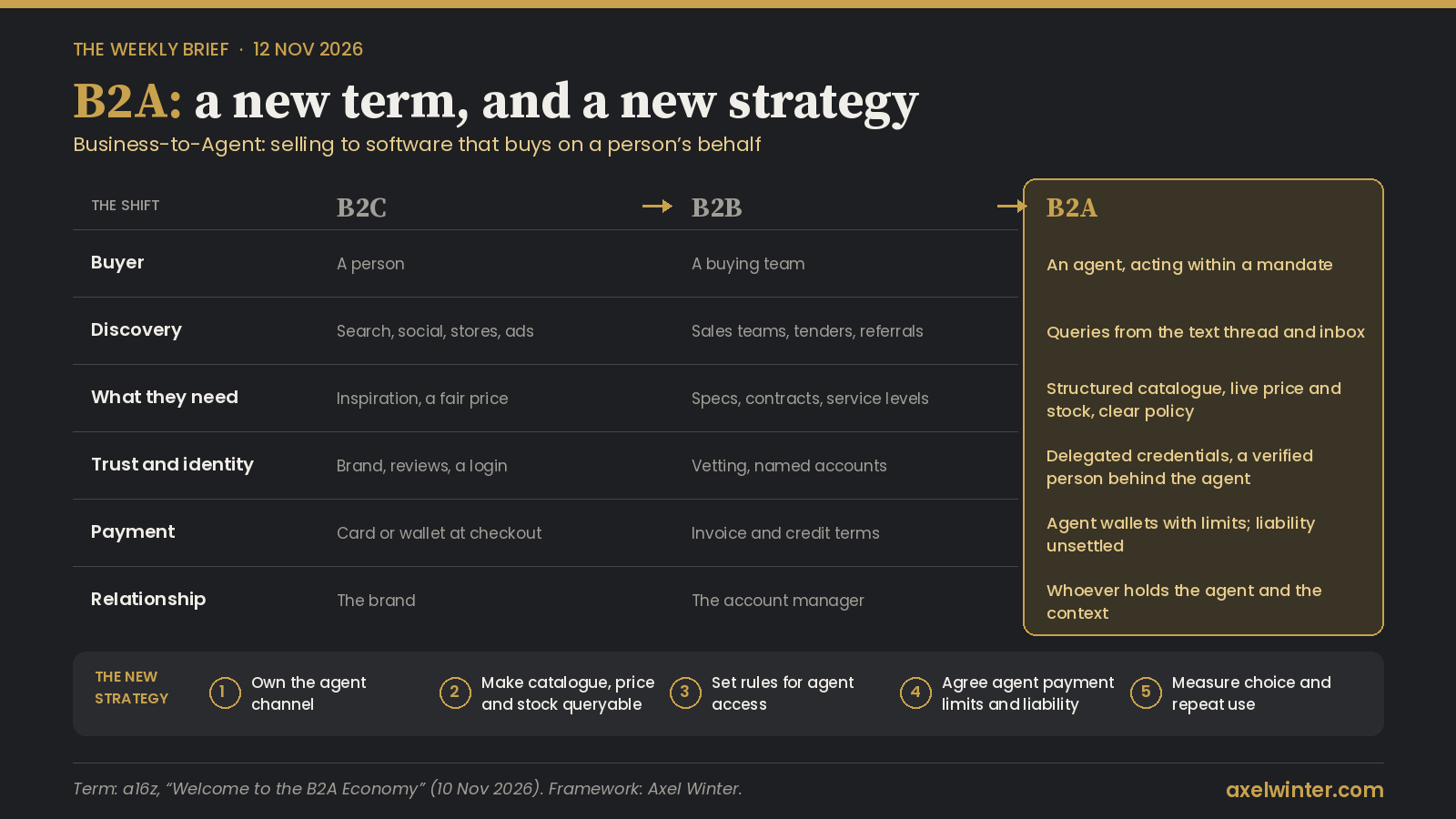
Business-to-agent means selling to software that buys on a person’s behalf. The term is a16z’s, from their essay; the comparison below is mine. Retailers, the authors note, once “built walls to keep bots out” and now “will have to fight for bots’ business”.
| B2C | B2B | B2A | |
|---|---|---|---|
| Buyer | A person, choosing for themselves | A buying team, under procurement rules | An agent, acting for a person within a mandate |
| Discovery | Search, social, stores and ads | Sales teams, tenders, referrals | Queries to catalogues and assistants, from the text thread or inbox |
| What they need from you | Inspiration, convenience, a fair price | Specifications, contracts, service levels | Structured catalogue, live price and stock, clear policy |
| Trust and identity | Brand, reviews, a login | Vetting and named accounts | Delegated credentials and proof the agent acts for a verified person |
| Payment | Card or wallet at checkout | Invoice and credit terms | Agent wallets with spending limits; liability still unsettled |
| Who owns the relationship | The brand, if the customer returns | The account manager | Whoever holds the agent and the customer’s context |
| What “marketing” means | Persuading people | Persuading committees | Being the clearest, most reliable answer |
This is a strategy question, not a channel tweak. A new channel changes where you sell; B2A changes who is doing the choosing and what they value. An agent is not moved by a campaign. It is moved by data it can trust and terms it can act on, and most rows of that table have owners outside the digital team.
1. The argument: distribution, not capability
Every earlier platform shift, the essay says, paired a new capability with a new route to customers. AI “has overperformed on the first and underperformed on the second”. The early figures it cites: Shopify’s AI-driven traffic up eightfold year on year in the first quarter of 2026, orders from AI-powered searches up nearly thirteenfold, and agentic browser traffic up eight times between August and October, according to Human Security.
In August I wrote that retailers were doing the plumbing work to “turn AI from a chatbot into a transaction channel”. a16z names who sits at the other end, and notes that generative engine optimisation “largely stops at discovery”, while agents carry on into evaluation and purchase.
2. Who is on the map, and what they do
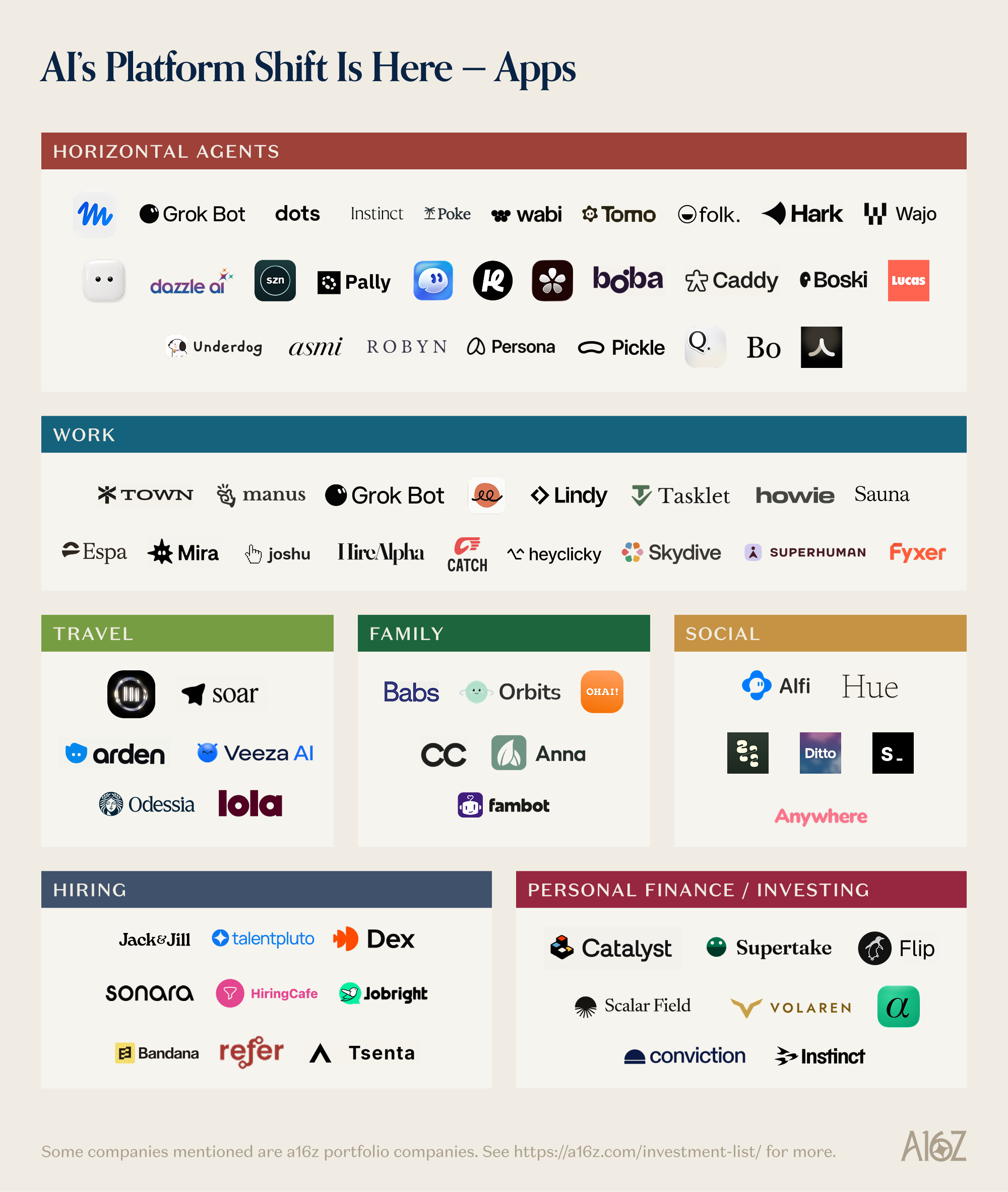
The apps map groups about 80 consumer agents into seven categories: horizontal agents (29 logos by my count), work (17), hiring (9), personal finance and investing (8), and travel, family and social (6 each). There is no shopping category. Buying happens inside general assistants. I looked up ten of the companies. Read against the framework, each shows where it meets the buyer and how far it goes on trust and payment.
Poke (horizontal). Made by The Interaction Company of California, Poke is an assistant you reach by text message over iMessage, SMS and Telegram, with no app to install. It helps with daily planning, the calendar and reminders. TechCrunch reports a $15m seed round, a further $10m at a $300m valuation, and only limited WhatsApp support because Meta barred general-purpose chatbots. In July Cognition, the maker of the coding agent Devin, brought the company in, saying users had exchanged more than 100 million messages with Poke in three months.
Instinct (horizontal, and again under personal finance). An invite-only agent that works over iMessage, WhatsApp and email, The Verge found, with a secure vault for website logins. TechCrunch describes it using its own phone number and computer to book travel and restaurants, buy things, pay bills and cancel subscriptions, plus a concierge that phones businesses without online booking. It raised $1bn at a $10bn valuation in September and has not published user numbers.
Manus (work). A general-purpose agent that runs research, coding and data analysis in its own cloud computer. Based in Singapore, it reported more than $100m in annualised revenue eight months after launch; after Beijing unwound its sale to Meta, Reuters reports it has since raised more than $500m. Decrypt notes a new Manus app, Cue, that gives agents their own phone numbers and wallets, with spending capped by the user.
Lindy (work). An assistant that triages email, drafts replies in your voice, manages the calendar and handles follow-ups, reachable through iMessage, Slack and email. It now has its own phone number to make calls for you.
Superhuman (work). Its new Email Assistant (3 Nov) works inside Gmail and Outlook, labelling what needs a reply, drafting in your voice and archiving the rest. It never sends without permission; Superhuman says almost half of its drafts go out unedited.
Fyxer (work). A London-based email and meeting assistant for Gmail and Outlook, Its press page puts annual recurring revenue growth in 2025 at $1m to $30m; OpenAI’s case study reports 90% of users retained after 90 days. It raised $30m in a Series B led by Madrona.
Odessia (travel). A conversational travel agent founded by Sonder’s Francis Davidson. It raised $6m from Sequoia, says it planned millions of dollars of trips in five months, and on 10 November was acquired by OpenAI and shut down.
Babs (family). A “family operating system” that reads a parent’s Gmail, pulls dates, deadlines and to-dos out of school and club emails, and proposes calendar entries. It acts only after the parent confirms.
Catalyst and Supertake (personal finance). With Catalyst, backed by Sequoia, you describe an investment idea in plain language and agents analyse signals, pick instruments across venues and deploy the strategy within set limits. Supertake, incubated at Union Square Ventures, turns a “take” into a portfolio and places the trades through agents inside existing brokerages such as Robinhood and Coinbase, either on approval or on “Autopilot”.
3. The pattern, row by row
Discovery: agents live in the thread and the inbox. Almost none of these companies asks for a new app. They sit in iMessage, WhatsApp, Gmail and Outlook, and read what arrives there. Order confirmations and loyalty messages are increasingly read by a machine before a person. In Southeast Asia the equivalent surfaces are LINE and WhatsApp, and Poke’s experience with WhatsApp shows the platform owner decides who gets in.
In September I argued that “the chat is the superapp now”, with ChatGPT as the example. The map extends it to every messaging app, and the merchant is rarely the one holding the conversation.
Needs, trust and payment: four things from a merchant. Agents want a catalogue they can query, live price and availability, clear policies on returns and cancellation, and a way to identify the customer and take payment within a limit. Evidence on the first is mounting. Digitec Galaxus has opened about 13 million items to Claude and ChatGPT, and McKinsey finds brands’ own sites supply only 1% of what AI models cite for consumer goods. My own line in September was “Fix the catalogue for machines, not humans.” The startups add the other three needs: Instinct’s login vault, Cue’s capped wallets and Supertake’s Autopilot are all attempts to give an agent identity and a budget.
Relationship: it moves to the agent. This is the part that complicates my earlier view. In the same piece I wrote that the “360-degree customer” is a myth, because a retailer only observes its own slice of a shopper’s life, and Thailand’s data protection law rightly limits how far it may reach beyond that. I still think that is right for retailers. But an agent with access to someone’s inbox, calendar and receipts does see across merchants, with the customer’s consent. The complete view exists; it simply sits with the customer’s agent. And the platforms are buying that layer: OpenAI took Odessia, Cognition took Poke, Meta tried to take Manus.
In August I put it as “Models are rented. Context is owned.” For enterprises that still holds. For merchants facing B2A, the uncomfortable corollary is that the context about their customers is now being owned by somebody else.
4. Thailand & SEA: the thesis at home
Asia shows both sides. Singles Day brought nearly 80 million users to JD’s shopping assistant, Reuters reports, yet unnamed industry sources quoted by the 21st Century Business Herald put 30-day retention for AI shopping tools at about 3%. In Bangkok, Central Retail says its CENNI assistant lifted conversion from browsers to buyers 1.7 times (a company figure, no baseline disclosed), though that assistant serves people rather than outside agents.
At Siam Piwat, the ONESIAM SuperApp runs on a platform we own, with semantic search and an AI campaign system on one data layer and an AI companion for stores, events and offers; a concierge robot pilot began at Siam Paragon on 2 November. For a mall, B2A means hundreds of tenants and an agent that wants one clear answer on stock, service and booking. Providing that answer, while tenants keep control of their data, is where I expect our next effort to go.
5. Banking & payments: the trust and payment rows
Catalyst and Supertake already trade through brokerages; Instinct pays bills; Cue hands agents wallets. a16z says the strain shows first in “payments, fraud and identity”. In September I wrote about AI agents inside bank vendors’ software: “The controls assume you own the runtime.” B2A makes that harder still, because the agent arrives from outside, on the customer’s instruction.
The banks’ answer is taking shape. Deutsche Bank and Ant Digital’s white paper (9 Nov) argues for “bounded agentic execution”; Ant Digital’s president, Zhuoqun Bian, writes that agents’ “authority must be explicit, machine-readable, bounded, and revocable.” In Thailand the BoT plans baht stablecoin rules for March 2027, with transfers only between KYC-verified wallets and programmable payments as a later use; the consultation is reported to close on 17 November.
The connection
Read together, the essay and the startups describe one shift: the customer’s agent sits in their messages, holds their context and spends within a budget they set. Merchants who can answer it clearly, and banks that can honour its mandate safely, will be chosen. The rest will be described to the customer by someone else, and paid through someone else’s rails.
What this means
For Southeast Asian malls and retailers, B2A is a commercial question before it is a technical one: who owns the agent channel, what we let agents do, and what we give up when the relationship runs through them. For banks, it is about mandates and liability, whether or not they build agents themselves. a16z notes most enterprises still block agent traffic; that may feel safe, but it hands the conversation to whoever lets agents in.
What to do
One move for each row of the framework:
- Buyer: give the agent channel an owner, and report agent-referred traffic and orders as a segment.
- Discovery and needs: publish catalogue, price, stock and returns terms in a form an agent can query, and treat confirmations and LINE messages as data.
- Trust and identity: write an agent access policy covering which agents you welcome, what they may do, and when a person must confirm.
- Payment: ask your bank how it will handle agent-initiated payments, limits and liability, and whether to respond to the BoT consultation.
- Relationship and marketing: measure how often agents choose you and whether customers return, with 30-day retention against a stated baseline.
Background
The term B2A is a16z’s; the framework table is my own. Logo counts are my reading of the a16z maps. Company facts and traction figures are as the linked sources state them. The Chinese retention figures come from unnamed industry sources.
If this was useful, please do pass it on to anyone weighing what agents mean for their channel plans. Replies are always welcome, and I read every one.
Axel
axelwinter.com
You must be logged in to post a comment.