

Stripe pays $7B+ for a switchboard, NVIDIA pays $6B for a model factory it won’t sell you, and your moat just moved to the context layer.
Executive summary
Most AI transformation programmes begin with a workshop. Twenty people, a wall of sticky notes, and a prioritised list of use cases that mostly reflects who spoke loudest in the room. Six months later the pilots are running, the budget is spent, and the P&L looks exactly as it did before. The models were never the problem. The starting point was: nobody actually knew where the value sat.
Last weekend a founder showed me the alternative. His agents plug straight into ERP systems, banking platforms and server logs — Oracle, SAP, no integration project, no middleware — read the raw files, and assemble a live productivity dashboard on their own, with improvement proposals attached to the evidence. Not a survey of what people believe is slow. A measurement of what is slow, taken from the systems of record. That is a fact-based foundation for AI transformation instead of a room full of opinions — and it is most of the difference between the programmes that show up in the P&L and the ones that quietly never do.
Two things had to become true for that to work. The agents have to reach for whichever model suits each task — reading a scanned invoice, reconciling a ledger, drafting the recommendation — because no single model is best at all three. And the context has to be threaded across those sources, so the system knows this invoice belongs to that bank transaction and that log event. The first is a routing problem. The second is a graph problem.
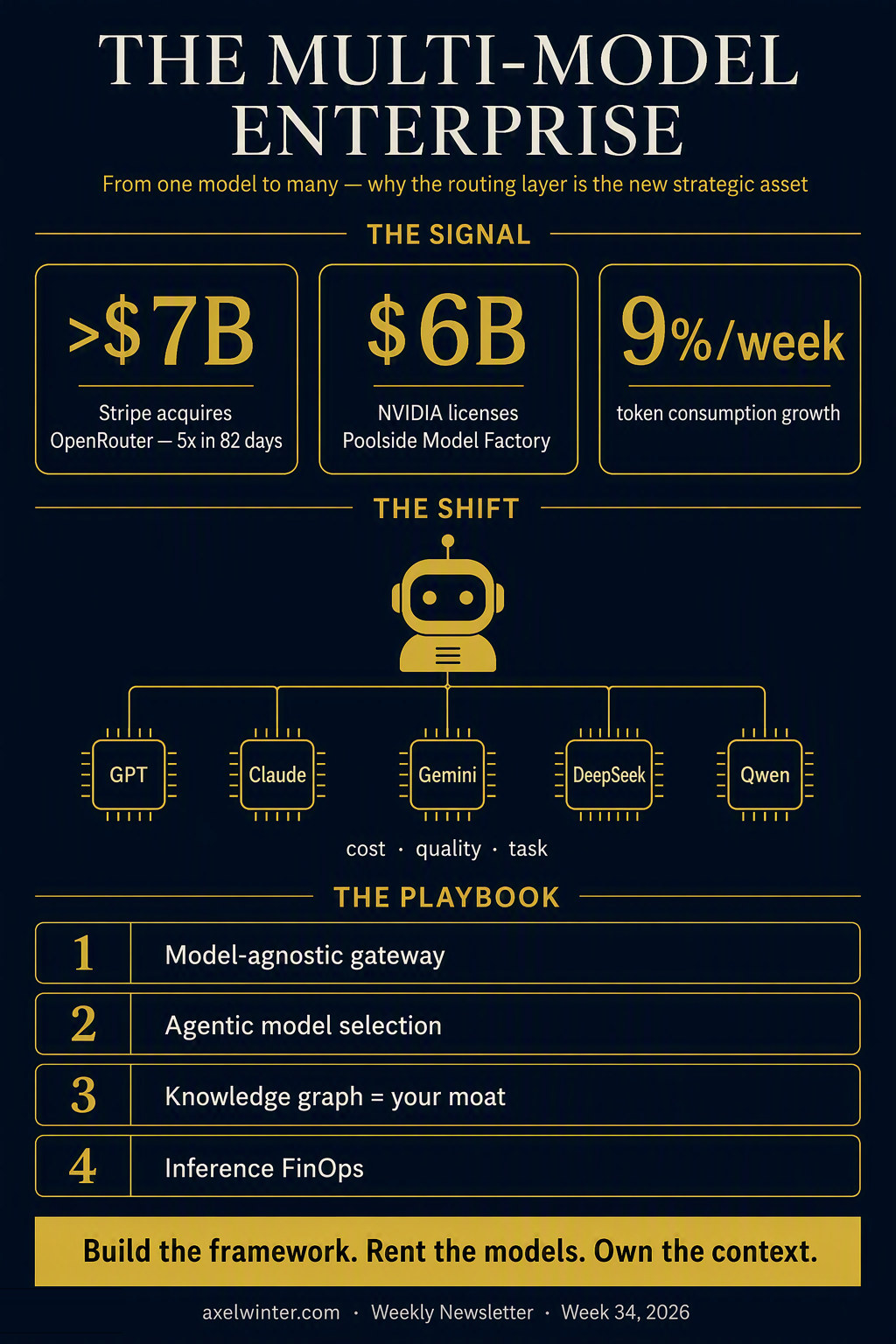
Both of those bets got priced this week, at record numbers. Stripe has agreed to acquire OpenRouter, its largest acquisition ever, at a price Bloomberg put at more than $7 billion (Aug 16); Stripe confirmed the agreement in its own newsroom announcement days later. OpenRouter is, in essence, a universal switchboard between a business and every AI model on the market — 400+ models from more than 80 providers. Engineers call it a routing or abstraction layer; in plain terms, you plug in once, and any workload can then use whichever model is best and cheapest for that job, today and every day after. Days later, NVIDIA agreed to pay $6 billion to license Poolside’s “Model Factory” software, hire 109 of its people, and invest another $1 billion at a $12 billion pre-money valuation (Newcomer and The Information, Aug 20–21 — this one still rests on a leaked investor letter, with neither company confirming publicly). When the payments giant and the GPU giant both spend record sums on the layer between the enterprise and the models, they are telling you where the value is migrating. The era of the single-model enterprise is over.
My position is unambiguous: corporate leaders must stop treating model selection as a procurement decision and start treating it as a runtime decision. Agents will pick the model per task, per token, based on cost, quality and ROI — not your CIO. And the corresponding capital-allocation conclusion is just as clear: do not build your own data centers, do not stockpile GPUs. You will not win the allocation game. Anthropic has signed $9.1 billion of compute with a bitcoin-miner-turned-datacenter operator (Bloomberg and CNBC, Aug 10–11), and NVIDIA has assembled a $500 billion AI infrastructure financing alliance with six of the largest asset managers on earth (Aug 10). You are not in that queue.
What you should build instead is expertise: your own switchboard — a model-agnostic abstraction layer between your business and the models — agentic orchestration with cost/quality telemetry, FinOps for inference — and above all, a context layer that makes any model smart on your data. Models are rented. Context is owned. That is the strategy section of this letter, and it ends with a five-point CEO agenda.
Why now: the week the switchboard got priced
1. Stripe–OpenRouter: the switchboard is now core payments infrastructure. OpenRouter raised a $113 million Series B in May 2026 at a $1.3 billion valuation, with Sequoia, Andreessen Horowitz, Menlo Ventures and Alphabet’s CapitalG. Under three months later, Stripe is paying north of $7 billion — some reports put it closer to $8 billion, mostly stock. Read that again: more than 5x in under a quarter, for a company Sacra pegs at roughly $140 million in annualized revenue. Why? Because the usage curve is vertical. OpenRouter now processes more than 10 trillion tokens per day across 400+ models for over 10 million developers and companies, and says it has seen at least 10x growth in inference volume every year since founding. Stripe’s investor letter of Aug 19 puts token consumption compounding at 9% per week year-to-date. OpenRouter’s founding thesis, restated in the deal announcement, is the whole argument of this newsletter: intelligence will be multi-model, no single model wins every task, and the frontier keeps moving.
2. NVIDIA–Poolside: even model labs can’t get GPUs. Poolside’s letter to its own investors is unusually candid about why it stopped building frontier models: capital requirements went vertical, and at the end of last year the company had a six-week window to raise $2 billion to pay for a 40,000-GPU cluster coming online in January. It missed the window and lost the cluster. So NVIDIA is paying $6 billion for the software and the team, plus a $1 billion investment. Context matters: NVIDIA has tripled its cloud spending on in-house model training to roughly $28 billion through 2031, has built out the Nemotron open-model line, and this month shipped Nemotron 3.5 Lightning — a ~30-billion-parameter agentic model — alongside NeMo Switchyard, an open-source library that routes tasks across models. Read that last one twice: the company that sells the GPUs is now shipping the routing layer. Its trillion-parameter Nemotron 4 is still in training, with no confirmed release date and late autumn as the earliest target. Open models are NVIDIA’s demand engine for GPUs, and GPU scarcity is pulling model labs into its orbit. If a well-funded frontier lab cannot get allocation, neither can your retail group, your bank, or your luxury brand. Full stop.
3. Automatic model selection went mainstream in the enterprise stack. On Aug 18, Snowflake announced dynamic model routing inside its Cortex AI Gateway: the gateway now selects the model with the best balance of quality and cost for each task, sending repetitive work to efficient models and reasoning-heavy work to frontier ones, and it is adding the open models DeepSeek-V4-Flash and GLM-5.3. The economics justify it. OpenAI’s own price list puts GPT-5.6 Sol at $5.00 per million input tokens against Luna at $0.20 — a 25x spread inside a single model family — and the published range for routing-based savings runs from roughly 40% to 85%, depending on how your workload is distributed. Meanwhile inference prices keep falling: OpenAI cut Sol’s API pricing by more than 20% on Aug 21 (promotional, for three months), after Luna dropped 80% on July 30 to $0.20/$1.20 per million tokens. Open-weight cadence is relentless — DeepSeek V4, Qwen 3.5 and 3.6, Mistral Large 3, the GLM-5 family, Kimi K3 — while Llama has stalled with no Llama 5 in sight. Committing to one model today is committing to obsolescence on a 90-day cycle.
4. And the quality table doesn’t line up with the price table. Cost is the easy half. The harder half is that capability now diverges by task and does not track price. On the Artificial Analysis index this month, the model ranked second overall costs twice as much per token as the model ranked first — and scores lower on intelligence, coding and agentic work. GLM-5.3 sits sixth overall yet lands within a rounding error of the leader on agentic tasks, at roughly a quarter of the price. Across the frontier tier, coding scores compress into about three points while prices span 25x. There is no single ordering of models any more, which is precisely why the choice has to be made per task, at runtime, by something that measures. Standardising on one vendor means choosing to be wrong on most of your workloads and paying a premium for it.
The strategy: buy tickets, not the railway
Two weeks ago I flagged that GPU allocation — not capital, not ambition — had become the binding constraint in AI. This month proved it at the top of the market. Anthropic’s $9.1 billion Riot Platforms compute deal and NVIDIA’s $500 billion financing alliance with Apollo, BlackRock, Blackstone, Brookfield, Goldman Sachs and KKR are rationing mechanisms dressed up as partnerships. Corporates reading this newsletter will never see that hardware. The good news: you don’t need to. Inference is a utility, prices are falling steeply every quarter, and open weights are a release or two behind the frontier and closing. What you need is the layer that arbitrates between utilities. Four builds, in order of priority:
(a) Your own switchboard — a model-agnostic layer in front of everything. No workload in your enterprise should talk to a model directly; it should go through one layer — a platform gateway, a commercial router, or a thin one you build yourself. Think of it as an abstraction layer: your teams build against it once, and the models behind it become swappable parts. This is your switching-cost insurance. When an open model undercuts your incumbent by 85% at equal quality, you want a config change, not a re-platforming project.
(b) Let agents pick the model — with telemetry. The agents choose the model per task; you set the policy. That requires instrumentation most enterprises don’t have: per-task quality scores, latency distributions, and cost per successful outcome — not per token. Stripe didn’t pay $7 billion for a proxy. It paid for the telemetry and the trust.
(c) The context layer as the durable asset. More on this below — it deserves its own section because it is the only layer that appreciates rather than depreciates.
(d) FinOps for inference. At 9%-per-week compounding consumption, inference is becoming a P&L line that rivals logistics. You need unit economics per agent, per workflow, per customer interaction — and policies that enforce them automatically. A 25x intra-family price gap is not a curiosity; it is your margin leaking.
Models are rented. Context is owned.
Here is the uncomfortable corollary of the multi-model world: if models are interchangeable utilities, then nothing about your model choice differentiates you. Your competitor can rent the same intelligence next Tuesday. The only thing that cannot be rented is your proprietary context — your customers, your products, your pricing logic, your operational history — structured so that any model can use it.
Go back to the dashboard I opened with. Every agent in it is rented and every model is interchangeable — the founder could swap all of them next quarter and the product would still work. What he cannot rent, and what took the real effort, is the graph threading context across ERP, banking and log data so the system knows this invoice belongs to that transaction and that log event. Whether his particular company wins, I don’t know; the platform vendors are coming for the same ground, and governance will decide who scales. But the split is the lesson: the agents and models are rented, the graph is the product.
That is what the context layer is for, and the mechanism is worth understanding even where the tooling is still maturing. A graph lets an agent retrieve the specific slice of your business a question actually needs — the entities and the relationships between them — instead of a pile of loosely related text. Published benchmarks on graph-backed semantic layers over relational data report token reductions averaging 20–30% against static schema approaches, and up to an order of magnitude on simple queries, while improving accuracy on complex multi-table questions by around ten percentage points. Better answers on fewer tokens, model-agnostic by construction. In a world of collapsing inference prices, the context layer is also your cost strategy — and the one asset that survives every model swap, every acquisition, every IPO. The same split runs through the four-layer luxury AI stack I mapped last week: the layer that compounds is the one the operator owns.
The business read: architecture, not model choice, separates winners
Anthropic is going public. It has filed confidentially with the SEC, with an autumn Nasdaq listing reportedly targeted, and ahead of that it has told prospective investors that Q2 revenue came in above $11.5 billion — against $787 million in the same quarter a year earlier and $4.73 billion in Q1 — with positive adjusted operating income for the first time. Fourteen-fold, year over year. The model layer is consolidating into a few enormous, capitalized utilities. Fine.
Which brings us to the number everyone quotes. The MIT finding — that 95% of enterprise AI pilots show no measurable P&L impact within six months — is a narrower claim than the headline usually implies, and more damning for it: six months is exactly the window in which a board expects to see something. PwC’s 2026 analysis points the same way, with a small leading minority of organisations capturing the large majority of AI value. Everyone else is subsidising the experiment.
Connect the dots. The winners are not winning because they picked a better model — the models are rented, remember. They are winning because they built composable, model-agnostic architecture with owned context and disciplined inference economics. Exactly the switchboard-and-context approach above. The 95% are the ones who signed an enterprise agreement with one model vendor, built point-to-point integrations, and now face a rebuild every time the frontier moves — which is now every quarter. It is the same pattern I traced when retail started out-investing banks in AI: the gap opens up in architecture long before it shows up in the budget.
And if you doubt the leverage this stack creates, look at what the same economics are doing at the individual level. Stripe’s economics team found that the number of solo operators on its platform clearing $1 million a year more than doubled between 2023 and 2025, while those crossing $5 million and $10 million nearly tripled. One person plus agents plus rented models now does what took a department. Enterprises are not exempt from that arithmetic — they are just slower to feel it. The same abstraction economics that are minting million-dollar solopreneurs will reprice every cost structure in your group. The only question is whether you run the switchboard, or compete with someone who does.
What this means for a group in Bangkok
Now translate this for the business most of my readers actually run: a Thai or Southeast Asian group with three decades of accumulated systems, a store or mall network, a loyalty programme, often a payments arm, and a technology budget defended line by line. The multi-model argument lands harder here than in Silicon Valley, not softer. You were never going to win GPU allocation — that contest was over before it started, and it costs you nothing, because inference is a utility you can rent at falling prices from a Singapore region. What you do have is the one thing no Californian platform can buy: decades of transaction, tenant, footfall and loyalty data across formats, in languages the frontier models still handle unevenly, on a customer base nobody else understands as well as you do. That is your context layer, and it is already sitting in your estate — unstructured, siloed by business unit, and undefended. The regional groups that win the next three years will be the ones that treat that estate as an asset to be graphed rather than a migration project to be postponed. Rent the models from anyone. Own the graph, or a platform will end up owning your customer.
The CEO agenda
- Ban single-model architecture decisions. Mandate that no workload ships without your switchboard — the model-agnostic abstraction layer — in front of it. Model-agnostic by default, within 90 days.
- Stand up agentic model selection with telemetry. Per-task cost, quality and latency dashboards; policies that optimize cost per successful outcome, not per token. Aim at the published 40–85% range for routing-based inference savings, and measure where you actually land.
- Kill the data-center slide in your capital plan. You will not get allocation; Poolside couldn’t. Redirect that capex ambition into orchestration talent and the context layer.
- Fund the context layer as a first-class asset. Graph-backed retrieval, persistent agent memory, a semantic layer over your core data. Measure it on two numbers — accuracy, and tokens consumed per answered question. Both should move.
- Institute inference FinOps with board visibility. At 9%-per-week consumption growth, this is a P&L line now. Unit economics per agent and per customer journey, reviewed monthly.
The models will keep swapping places — that is now someone else’s capital problem. Yours is the switchboard and the context. Build both.
One question worth putting to your own executive team this week: who in your group decides which model a given workload runs on — and is that a procurement decision signed once a year, or a runtime decision your systems make per task? If nobody can answer it, that is your first project.
Sources: Bloomberg and Stripe newsroom (Stripe–OpenRouter, Aug 16–19); Newcomer and The Information (NVIDIA–Poolside, Aug 20–21 — based on a leaked investor letter, unconfirmed by either company); Bloomberg and CNBC (Anthropic–Riot Platforms compute agreement, Aug 10–11); NVIDIA (AI infrastructure financing alliance, Aug 10); Snowflake (Cortex AI Gateway dynamic model routing, Aug 18); OpenAI published API pricing; Artificial Analysis intelligence index; Sacra (OpenRouter revenue estimate); Stripe investor letter and Stripe economics team; MIT research on enterprise AI pilots; PwC 2026 AI analysis.
— Axel Winter
Bangkok, week 34, 2026
You must be logged in to post a comment.