
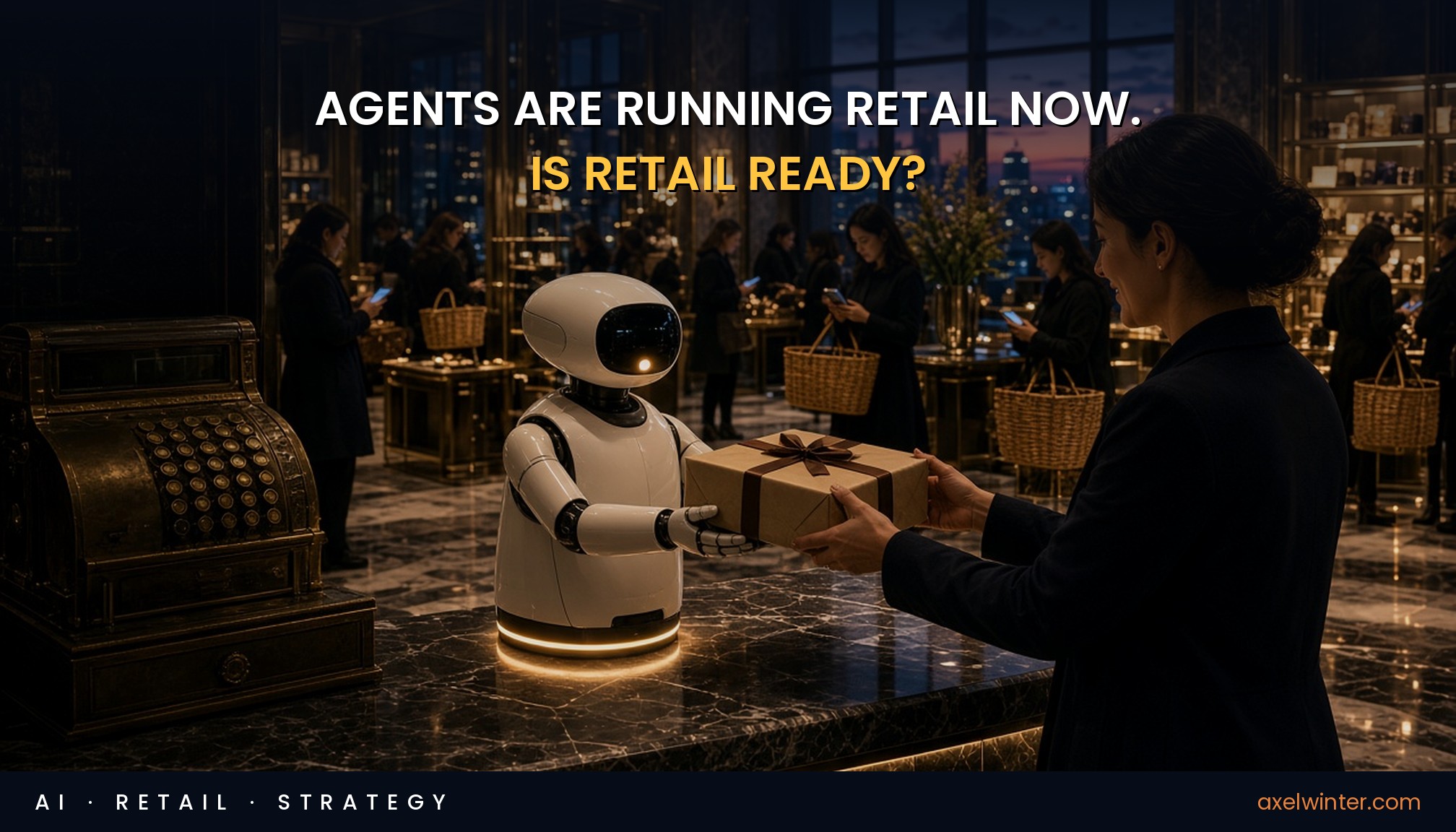
The Weekly Brief · 5 Nov 2026

Two months ago I wrote that AI in retail had stopped assisting and started operating; this week the industry put its foot down. Amazon says more than 400 million customers used Alexa for Shopping in the past year, Grab says merchants using its AI assistants see an uplift of about 20%, and Shopee has begun rolling out Migoo, its shopping assistant, inside the app. The foundations are lagging, though: BCG finds only 18% of retailers think their marketplaces are ready for agents, Retail Economics finds just 44% of UK retail leaders call their data highly ready, and Blue Yonder finds almost half of shoppers who bought on an AI’s advice have since sent something back.
PPC Land · Grab · Wiser · BCG · Retail Economics · Retail Dive
This week in 30 seconds
- The shift is speeding up. Muse launched in Singapore with Grab, Shopee and Lazada; Google opened checkout inside Gemini and AI Mode in Canada; Zalando unveiled its first agent; and Amazon’s own agent has been used by more than 400 million customers.
- Southeast Asia is not waiting. Grab says merchants using its AI assistants see an uplift of about 20%, and Shopee is rolling out Migoo inside its app.
- Readiness is the tension. Only 18% of retailers think their marketplaces are ready for agents, and almost half of shoppers who bought on AI advice have returned something.
The question is no longer whether retail moves to agents. It is whether retailers will be ready by the time their customers’ agents arrive.
1. Estée Lauder x Microsoft: beauty gets a single brain
On 2 November The Estée Lauder Companies announced a cloud, data and AI partnership with Microsoft, part of its One Operating Ecosystem and Beauty Reimagined programme. At its core is a unified data platform connecting brands, regions, channels and functions, with personalisation, productivity and margin expansion as the stated aims. Brian Franz has been building towards this since September, when he became Chief Technology & Transformation Officer.
I have long thought beauty would be among the first categories to be properly AI-led, because shade-matching, skin diagnostics and replenishment are data problems dressed up as matters of taste. ELC has now made it official: fewer fragmented brand stacks, one brain.
In 2018–19, at Central, I worked with a founder from China on an app for age recognition and personalised beauty recommendations. Generative AI and agents now do this far better, and Central Retail has just launched CENTRAL SKIN AI (22 Oct).
Retail Tech Innovation Hub · The Estée Lauder Companies
2. Agents reach the till
If the brands are building the foundations, the agents are now arriving to use them.
- Muse in Singapore (2 Nov). The personal AI agent launched with early connector partners including Shopee, Lazada, Grab, Agoda and Singapore Airlines, so users can compare prices before buying and plan groceries and dining through Grab. Connector features are arriving progressively.
- Google in Canada (4 Nov). Direct checkout, built on the Universal Commerce Protocol, is rolling out in AI Mode in Search and the Gemini app, with lululemon, select Shopify merchants, Shoppers Drug Mart and Simons. The retailer remains the seller of record.
- Zalando (3 Nov). Europe’s online fashion retailer unveiled its first AI shopping agent and plans AI-assisted checkout for other retailers’ products inside its app in 2027, in the same week its gross margin slipped to 38.7%.
- Amazon (29 Oct). Amazon is often described as shutting the door on outside agents. Its own numbers suggest something more deliberate. More than 400 million customers used Alexa for Shopping, its own agent, in the past 12 months, and US users spend 50% more per order than those who do not (Amazon’s figures, without a published method). Andy Jassy said shopping through outside agents is “still not great”. Amazon is choosing to own both the data and the agent.
Few retailers can do what Amazon is doing. For everyone else, the agent increasingly sits between the customer and the shop, and a retailer whose product, price and stock data cannot be read cleanly may simply not be part of the conversation.
Alvinology · Google Canada · The Business of Fashion · PPC Land
3. SOLUM AIR: the store becomes a network
On 2 November SOLUM set out AIR, short for AI for Retail, built on three pillars: Architecture, Intelligence and Revenue. In practice it is network infrastructure linking electronic shelf labels (ESLs), cameras, sensors and large e-paper displays, so that store data can flow in real time. The public debut is at NRF 2027 in New York in January.
ESLs stop being mere price tags and become a store-wide display and a media channel; cameras become the store’s eyes. For context, Morrisons agreed in October 2025 to fit 10.8 million VusionGroup ESLs across its 497 supermarkets, and in September added “shop to light”, where its Gemini-based Product Finder makes the right shelf label flash. The store is no longer simply where AI is deployed. Increasingly, the store is the computer.
PR Newswire · VusionGroup · Grocery Gazette
4. Thailand & SEA: agents on the ground
Grab’s third-quarter results (3 Nov) showed how this looks in Southeast Asia. Grab is piloting Muse in Singapore so customers can build GrabMart baskets in chat before checking out in the Grab app, and says merchants using its AI assistants see an uplift of about 20%. Anthony Tan made the point, we actually talked about it ahead of times: As agents become a new way to transact, “every order they place still needs to be fulfilled on the ground”, through drivers, merchants and logistics. (Disclosure: I sit on the board of GX Bank, which is part of the Grab group.)
Shopee is also starting to roll out Migoo, an AI shopping assistant inside its app for conversational product search, comparisons, deals and order tracking, although it is not yet clear when every user will have it.
In Thailand, the tone is pleasingly practical. The Bangkok Post’s “Betting big on small AI” (2 Nov) describes a push to help SMEs adopt focused, affordable AI tools; Dohome reports that its AI chatbot has reduced contact-centre workload by up to 70%, while TDRI estimates that 2.2 million Thai workers are at risk of AI displacement, a reminder that adoption and reskilling ought to travel together. CP Axtra, meanwhile, expects Makro PRO online sales of 100–110 billion baht this year, with online heading for around 40% of sales next year.
PYMNTS · Grab · Wiser · Bangkok Post: Betting big on small AI · Bangkok Post: CP Axtra
Background: who is getting ready
- BCG on agent readiness (21 Oct). Only 18% of retailers consider their marketplaces ready for agents. Nordstrom, before it could appear in agent results, first had to clean and enrich its product data and fix what was keeping its catalogue out. And just 4% of consumers would let an agent complete a purchase on its own, so for now the contest is over the recommendation rather than the checkout.
- SAP Storefront MCP Server. Announced at NRF in January 2026 as part of SAP Commerce Cloud, it lets AI platforms such as ChatGPT communicate directly with a retailer’s web storefront.
- The Mall Group. In May it described AI-driven recommendations built on an M Card membership base of more than seven million, with a multilingual virtual shopping assistant in development.
- Siam Piwat Group and Xponential. We are working on agentic CRM: agents that look after the customer relationship itself, not only the shelf. (Disclosure: Xponential is a joint venture of Siam Piwat and Pivot Digital, and I am its CEO.)
BCG · SAP News · Retail Asia
The connection

Several signals, one direction, and it is moving faster than I expected in September. Agents now shop on customers’ behalf at Amazon’s scale, inside Grab and Shopee, in Google’s search results and in Zalando’s app, while stores such as Morrisons and brands such as Estée Lauder rebuild around them.
The tension is readiness: when the product information underneath is poor, shoppers send the goods back. The retailers getting ready now (one customer graph, one inventory truth, one shelf network) are likely to be the ones whose agents actually work in 2027. The rest may find that someone else’s agent has already made the sale.
What this means, and what to do
- Get ready before the agents scale. A Retail Economics and PMC survey of 100 UK retail leaders, published in October, puts numbers on it: 69% have AI live or scaled, yet only 50% have connected foundations fully in place and 44% describe their data as highly ready. Of those with three or four execution prerequisites in place, 59% have scaled AI, against 6% of those with one or none.
- Treat the store as infrastructure. ESLs, cameras and sensors are not “digital signage”. They are the in-store equivalent of cloud, and deserve to be budgeted as such.
- Make live product and stock data readable by agents. Whether through MCP, Google’s UCP or an equivalent, if an agent cannot see your real shelf, it will recommend someone else’s, and if your descriptions are vague, the goods will come back.
- Keep an eye on Bangkok. Central Retail, The Mall Group and CP Axtra are each applying AI to beauty, CRM and B2B commerce at scale. What works here tends to travel well across Southeast Asia.
Next week I shall be watching holiday agent traffic. UBS analysts recently found that ChatGPT, Claude, Gemini and Muse increasingly treat Walmart as the default answer for everyday shopping. The foundations described above will be tested in earnest by Black Friday.
If you found this useful, do forward it to a colleague who is still running pilots. Subscribe below to receive the Weekly Brief each week, and I would be glad to hear what you are seeing in your own market.
Related: The AI Commerce Shift: Retail Is Driving Innovation Again · Retail Is Out-Investing Banks in AI — And the Gap Is Widening
Axel
axelwinter.com
One response to “Weekly Brief: Agents Are Running Retail Now. Is Retail Ready?”
[…] Last week I looked at agents at work inside retail, in operations and at the till. The a16z map points to the next step: the agent on the other side of the counter, buying for someone. This issue sets out a framework for that shift, looks at who is on the map, and asks what it means for malls, retailers and banks in Southeast Asia. […]