
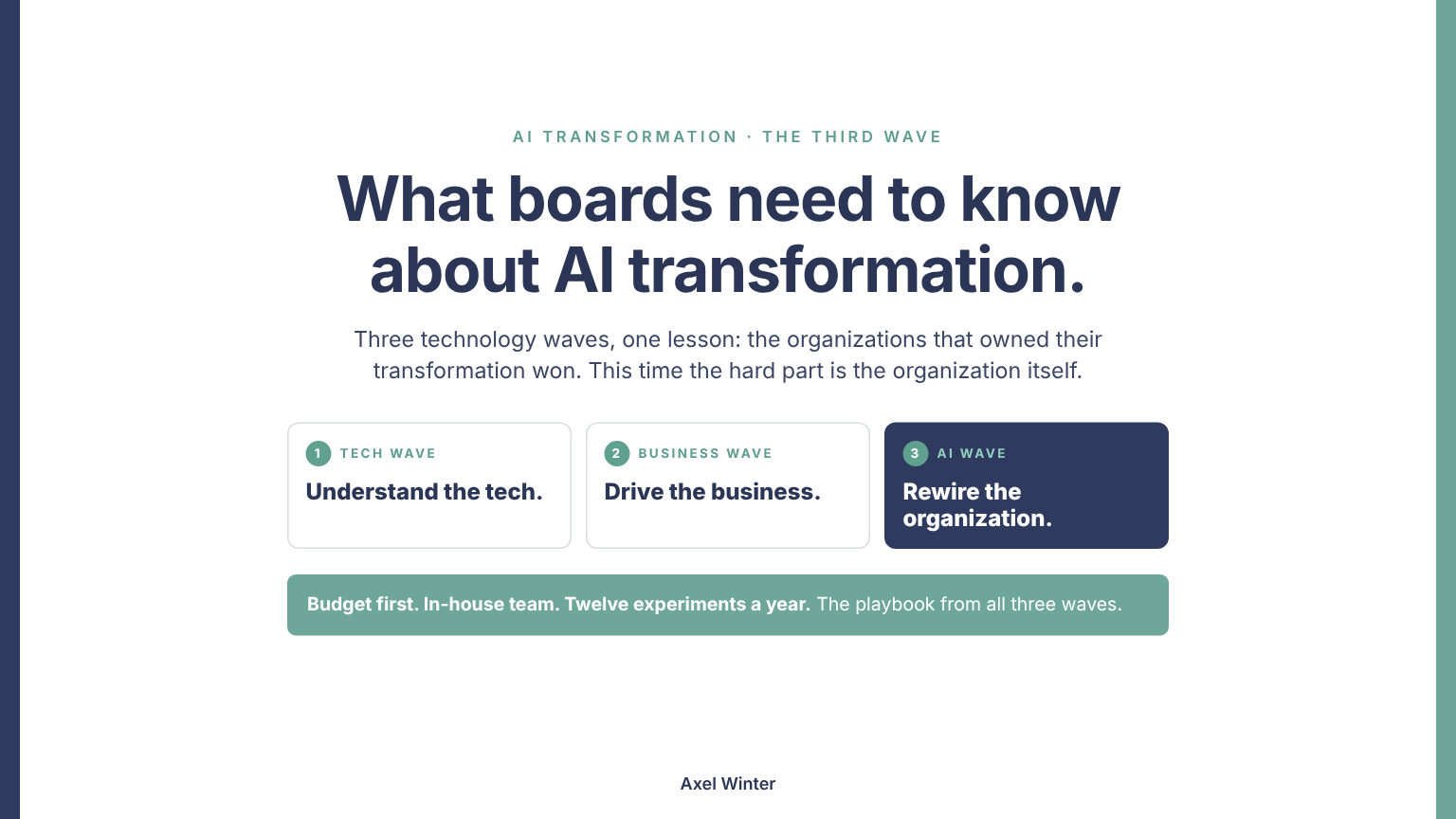
In early October I had the opportunity to meet a couple of bank executives in Cape Town. We discussed approaches to AI transformation, I shared my experience in this space, and it led to some profound discussions.
I have had the great opportunity to drive tech transformation a couple of times in my career — at Accenture, Deloitte, Cisco, GE Capital, Standard Chartered Bank, Central Group, CP Group and Siam Piwat — and to be part of journeys like the one at Grab.
Cape Town was exciting, as it turned into multiple lively discussions across the board — and even over dinner with friends!
The impression I got from the top-exec discussions:
- Everyone is focused on AI transformation — meaning we all recognize the opportunity and the need to transform organizations!
- Everyone has their top 3–5 use cases they are pursuing; some are set up more broadly and are actively pursuing a wider transformation strategy.
- Yet organizations embark on AI transformation with traditional programs, which are only capable of incremental shifts.
- Banks especially struggle to understand and define the ROI of AI initiatives — because the focus is too narrow, on individual projects, in an overly high-cost environment.
- Few are questioning the inherently strategic transformation topics — time to value, budget and overall platform strategy — as fundamental shifts.
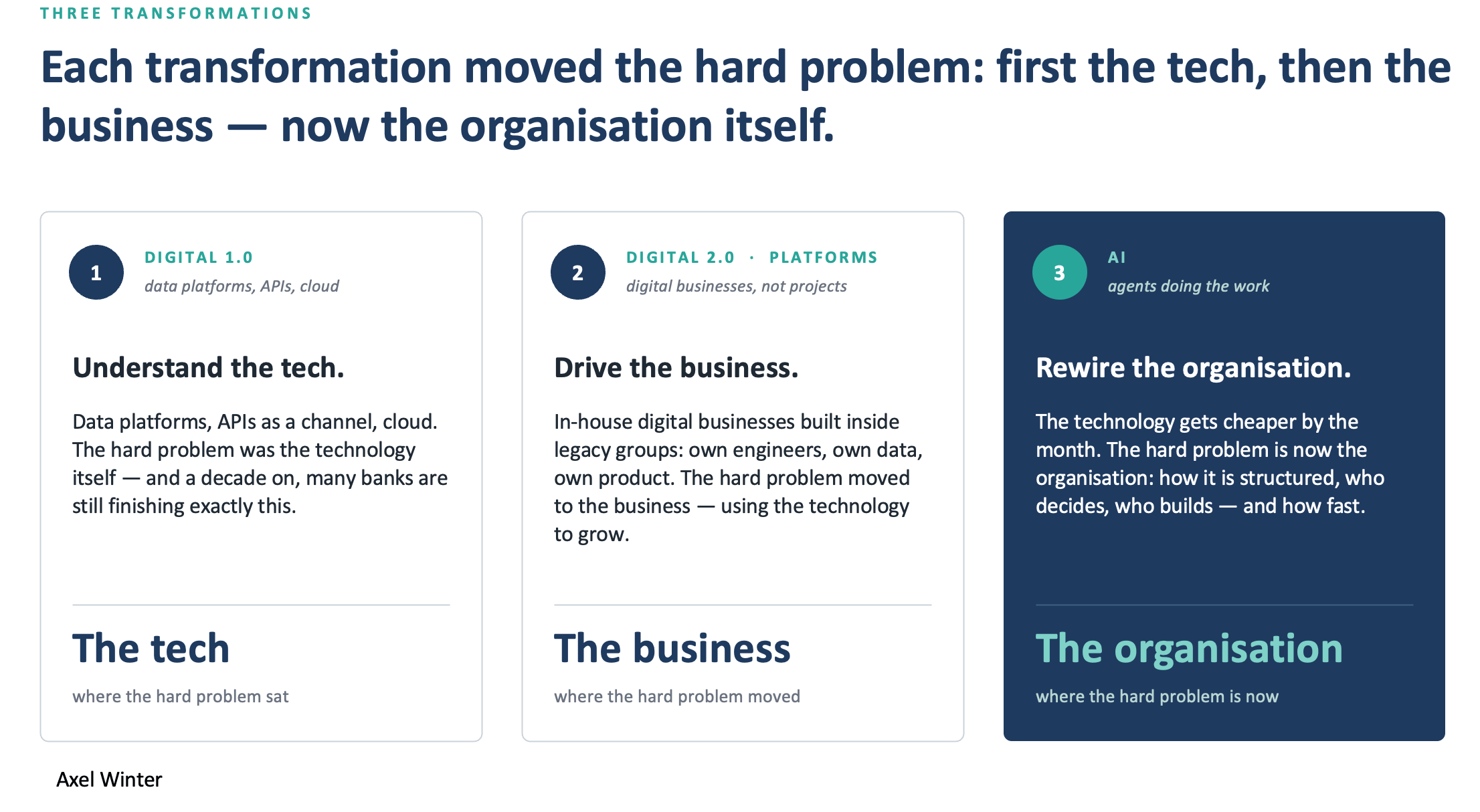
Three waves so far — and the third is the largest.
The tech wave
I had the opportunity to be across all of them! The first wave was really about getting out of legacy platforms and the legacy approach to technology: building more modern technology, or at least ‘hiding’ legacy behind modern APIs and middleware. The goal was a modern bank channel and a data-insights architecture. At GE Capital, as Global Chief Architect, I had the opportunity to do this for <500M customer accounts globally, and to deeply integrate customer origination with firms like Dell, Amazon.com and others. It also laid the foundation for more advanced management models, enabling strategic IT–business relationships.
At Accenture, just before joining GE, I co-wrote (with one other person) version 1 of the Global IT Strategy Methodology, and also had the opportunity to drive Strategic IT Effectiveness — an offering that aimed to get IT budgets to 70–80% innovation rather than ‘keep the lights on’ (which should be around 20–30% on average). It was also the age of leaning out processes, quality and excellence.
Both served many organizations as fundamental building blocks for consistent change! Yet organizations often don’t change holistically; they focus on modernizing a horizontal slice (infrastructure) or a vertical one (lending). This often generates overheads, which drive adverse impact.
The business shift
When I joined Standard Chartered, the digital transformation era was starting for early adopters like the bank. It was a combination of strategic changes — lower cost, agile feature delivery (rapid time to value), APIs as a banking channel (microservices) and data lakes (big data, Hadoop, etc.) — to drive a significant shift.
The data lake was a major force for the bank, and we were one of the first global banks to drive this strategy so comprehensively and at such scale. With global data search engines we were able to get almost any answer within an hour (things like: who are the top corporate counterparties who aren’t clients yet?). Data science and machine learning were launched, with features like Next Best Offer — use your credit card and get, in real time, a follow-up offer from our cards business within 1,000 steps of where you are. Customer segmentation and the first Customer Data Platform (CDP) followed. The bank also became one of the biggest Tableau customers globally. New channel apps with top-of-the-line UI, behavioral data, modern in-house core banking in the cloud, etc. — across 60 markets. This changed the bank forever.
This was also the time when the professional services industry scaled significantly, with many new players and new departments to address demand — and quality became uneven. Technical debt became a more common word in tech teams.
We started with agile delivery and an architecture targeting faster time to value, automating and reducing overhead by ‘leaning’ key process work.
When I came to Central, I learned from some of the best retailers in the world that the power of now = retail (and ‘retail is detail’), meaning you deliver massive features in days — and that was before AI coding. We designed a strategy where the core of the shift was a startup-like structure: building a team of some 450 people — people literally moved into the office for four years — to drive eCommerce, data analytics, machine learning, etc., and roll out digital products across business units globally, each within weeks. We also designed the accompanying organization in the business together, and teamed well with what I call ‘core IT’. The ‘tool’ that enabled this journey was being a startup inside the organization, driving rapid change, linked to a P&L rather than budgets. The CIO/CTO/CDO who invests and doesn’t spend.
The organizational shift
The common misconception is that the focus of AI transformation is process optimization. That is but a by-product, and it understates the impact AI has across organizations. The core is that AI is an organizational force multiplier. It drives the productivity of individuals, it changes jobs, and it helps to innovate new products and services. Only with this view can we formulate a strategy correctly.
Technology cost can easily be reduced by replacing costly vendors, and universal agentic end-user platforms can already today improve almost every staff member’s productivity instantly. Even in-mall staff in security or property care can become customer agents with an automated information and translation app.
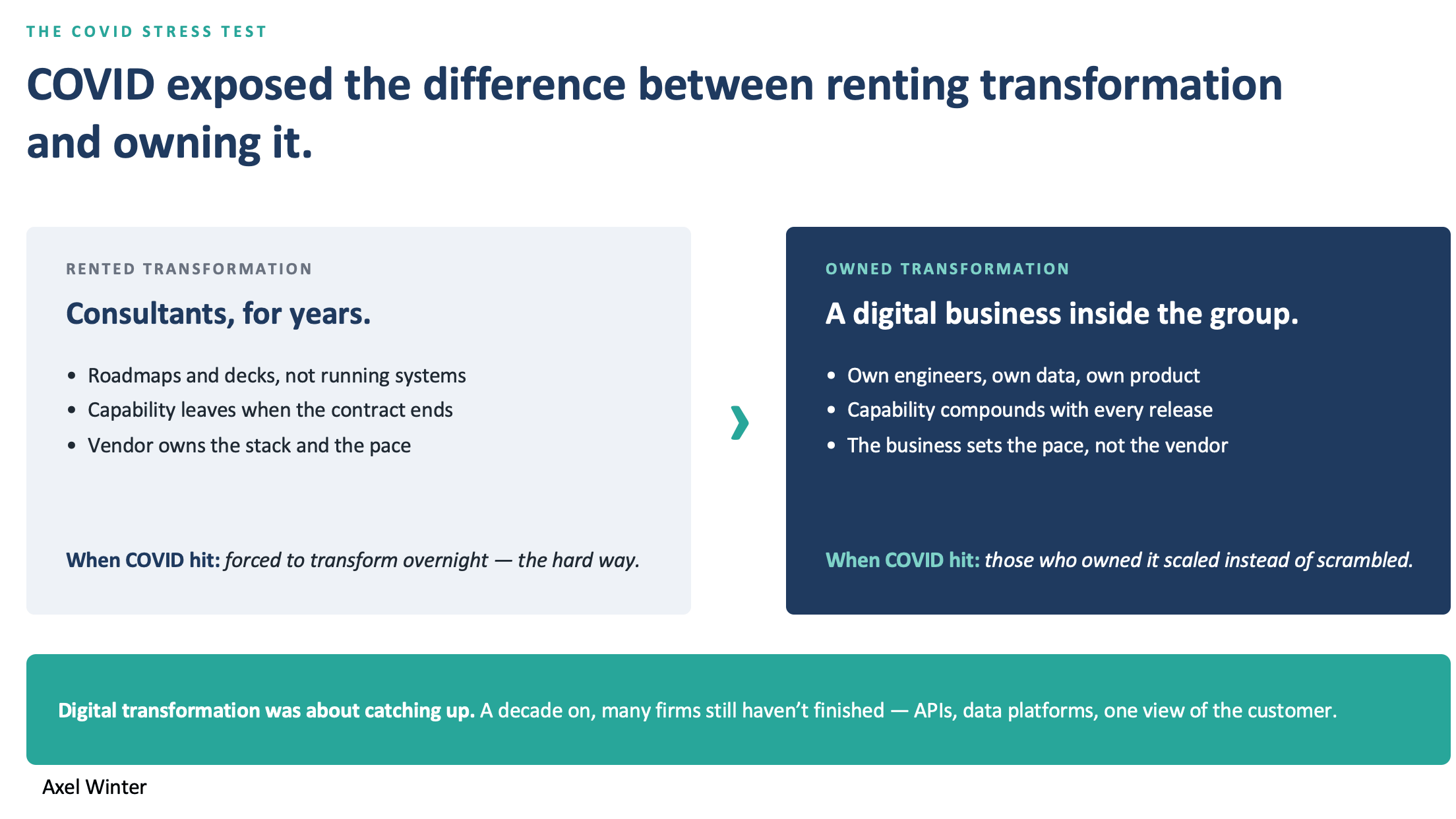
COVID came. The digital stress test of our time.
Firms that weren’t digital panicked and tried to transform overnight with consultants and vendors, in the shortest amount of time — but at a price. SaaS and mediocre software development became a ‘tax on the business’. Check the annual reports of public companies from that time and you can see how profitability was shrinking. Not following the playbook of strategic IT effectiveness drives the downside: more island solutions, higher cost, slower time to value and low ROI.
Firms like Central, which were already there, focused on scaling up, a more 24×7 tech model, and on COVID-appropriate feature development.
The interesting part is that all of the top organizations in the world use all of the top-tier consulting firms — both the strategy and management consulting houses and the IT/technology consulting houses: McKinsey, BCG, Bain, Accenture, IBM and the Big 4 (Deloitte, EY, KPMG and PwC), in no particular order.
By right, no one should have needed a digital transformation if the advice had been sound. GE did not need it, Standard Chartered did not need it, Central did not need it, CP Group — where I helped create in-house capabilities — did not need it, and neither did Siam Piwat.
Essentially, the message is that the approach must come from the inside. The expertise and the ability to experiment must be there. Augmenting skills can help. Looking at market best practices can help.
My focus is on market best practices, startups, free and open source, and the big tech firms. This is where we can learn the most, and where I consider how best to apply it to the execution engine I am building.
My learning from these, and from what I have done so far, is that AI is the most complex transformation journey — and hence the focus needs to be laser-sharp. We are shifting the organization, all its pieces, and the tech itself.
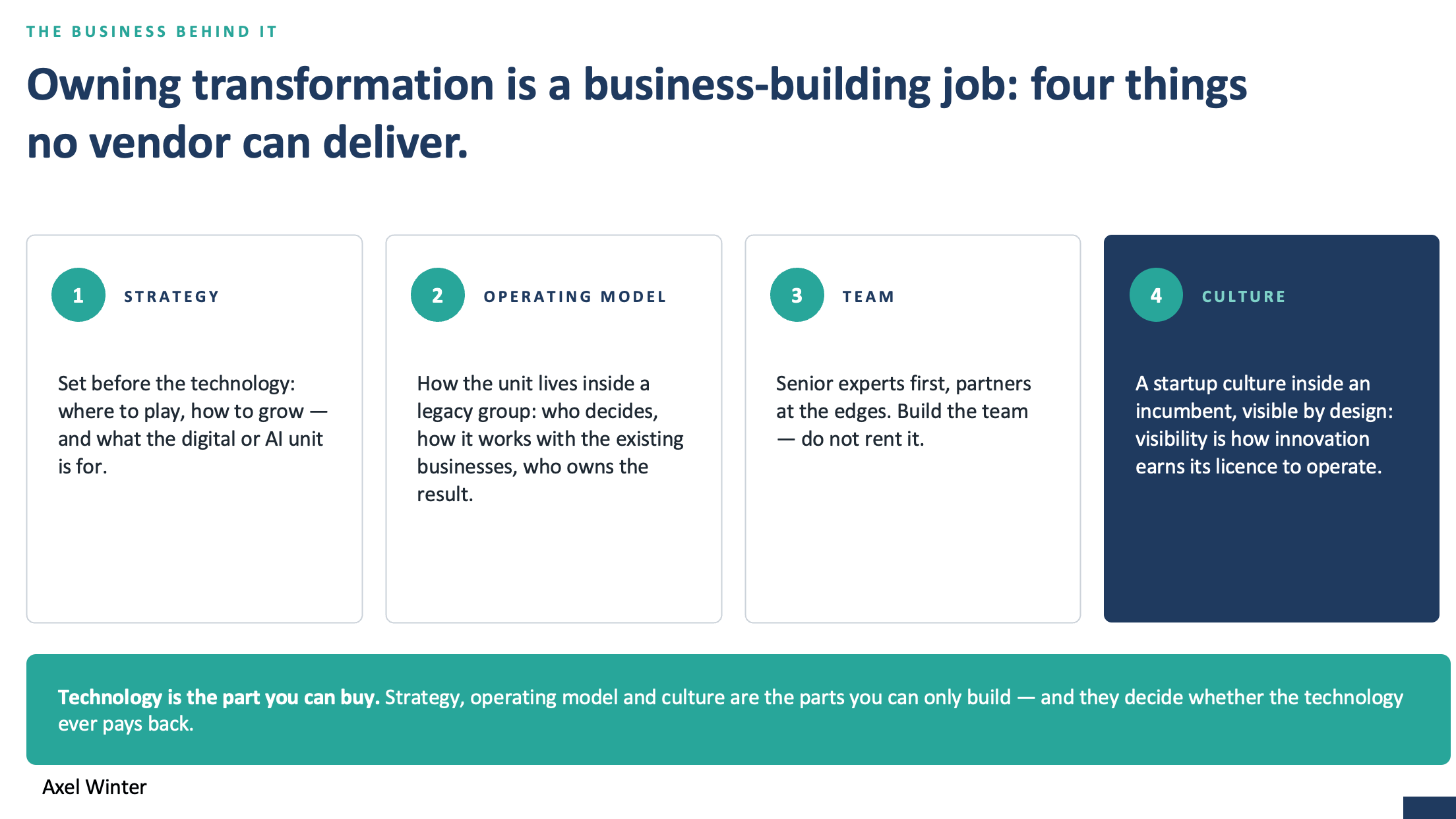
When transforming Central, the then COO/President and I went ahead over the course of a few weeks and developed the business strategy, a fitting operating model — especially how my unit would interact with the business units — and the organizational needs, and then built a strong team to have the capability to build the future.
The culture was intentionally that of a startup — agile and rapid delivery. I had HR, talent acquisition and finance also reporting to me, so as to drive a special culture, attract the best people, define growth opportunities and, rather than being budget-centric, focus on a P&L with a view to investing in the future rather than spending. Transparent, open, no fear, work & play hard — and based upon a clear IT/technology strategy, incorporating cloud and data first.
At Siam Piwat we opened Xponential exactly to drive this idea: take ownership of the digital experience and the AI transformation of the group.
- Create a startup within the corporate to drive fast change
- Define an operating model within Xponential and with the group
- Attract top talent
- Remove the cost overhead of SaaS and tech vendors through in-house creation
- Adopt AI and other technology not only to replace and improve, but also to innovate the business
- Strengthen the digital consumer and MarTech platform
We have also created AI training across the whole Siam Piwat Group, with an AI Ambassador in every department to help define the needs — and to avoid making this a top-down exercise.
The question often comes up: do I need a CAIO, a CDO or a CTO? In my experience, and as both examples show, empowerment is the single biggest question in transformation. One accountable leader needs to be able to decide across Business, Digital Product and the Technology involved. The more top-heavy you make an organization, each with very small teams, the more difficult it becomes to manage and the more dependencies rise — slowdown, higher cost. It is important to carve out the right number of departments, keep them focused, and empower execution. Meaning: the right leader matters more than adding structure.
It is vital that any transformation project is based on a holistic approach comprising these four dimensions:
Strategy
At this stage it is critical to establish AI as an operating platform for all business units and staff — with initial planning on the products & services that can drive incremental value, and a model to keep expanding adoption.
- Skill development across the enterprise
- Managing job displacement fears
- Balancing cost reduction and revenue growth with clear KPIs
- Decentralizing decision-making with a network of AI Ambassadors who work with experts to define and refine opportunities for AI adoption
- Knowledge sharing internally and with external partners
- Continuous innovation
Operating model
- With an expert team likely involved, plus a set of AI Ambassadors across departments and teams, how they work together becomes critical — while at the same time allowing a shift across the organization
- Design a process and organization for speed of change, which can anticipate and execute at will
- Avoid overly complex approval mechanisms, and define how departments can drive change with standard tools, linked to expert advice and custom development
- Enable rapid market testing to identify opportunities for change
Team
- Deciding on the organizational and capability structure is important. Given that AI is a force multiplier for strong skills and a strong organization, this means investing in top talent — not to supervise, but to execute and to provide critical knowledge.
- In this context I note that the most critical mistake organizations make is to trust external advisors or solution providers more than the in-house team. Executives need to consider their team’s input first and foremost.
- The most important part — and this I learned in my days at Accenture and at every company thereafter — is that it is critical to build a strong in-house team with the right capabilities across all key functions to drive exactly this shift. It can only be done with in-house skills, it can only be done with commitment, and it can only be done through rapid, ‘fast fire’ change.
- AI is new and still changing rapidly; ‘copy and paste’ is difficult, and hence it is important to have people who want to grow, learn fast and apply fast.
Culture
- With any major shift it is important to focus on culture development and to make decisions on positive culture changes. As an executive you own culture, whether you like it or not. Even if you outsource it all (not recommended), you still own the culture between staff and outsourcer.
- My perspective is to drive a culture of constant change, transparency, low management overhead, openness, constant learning and growth — but also NO FEAR, teaming, and focusing on goals.
- My own style is exactly aligned to that — what I call ‘tough in the argument, soft at heart’.
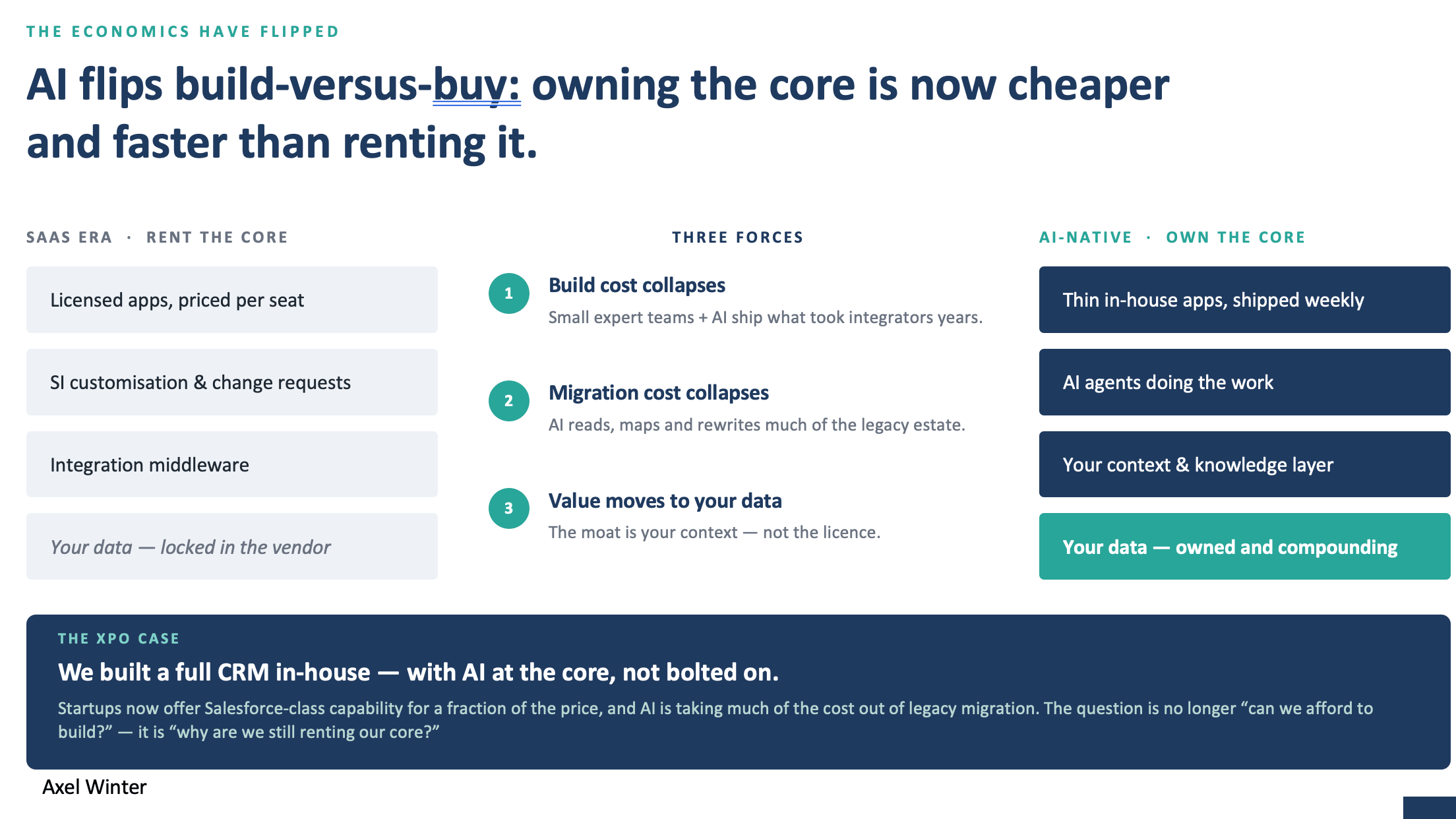
What if you could have any app feature you wanted at almost no cost and 100 times faster than ever before — what would you do with this power?
The real question becomes what to do with AI. AI changes the technology that can be used. Any ‘feature’ dream can more or less become reality.
With the right skills owning and developing the right technology, driving your organizational differentiation can be done easily — with the right capable team, in-house. What remains outside is either the one or two very complex platforms where you don’t have the business understanding to write them, or pure commodity platforms, which you can acquire cheaply and outsource. The rest is cheaper and better to own.
It sounds difficult for organizations that have not gone through the shift of replacing bought business solutions. It seems logical that a vendor platform must somehow be better.
Better for whom? Most organizations use some 30% of Salesforce.com — often the commodity features — and pay for the full platform. SaaS and other vendors need to sweat their assets; like all of us, they have what they have and have to sell it — no choice.
A key strategy is to replace SaaS vendors, and the costly integration with SaaS, with targeted software that drives higher productivity and feature innovation. Clearly, that needs a team with expertise in agentic AI software development and in running its platform. It needs a clear roadmap and strategy, by complexity and SaaS cost. It also needs a plan for how to make the best use of the freed-up budget.
The key is to have the strategy, operating model and capability for each path well defined: a capability roadmap, dependencies, delivery capability — and an aligned budget.
CRM (which Xponential has built), core banking (Standard Chartered), originations, eCommerce, marketplace, lending, credit risk, payments, customer data platform, personalization engine, order management, loyalty, etc. — and also the medical platform for the UK (Accenture at the NHS) and the first global B2B chemicals marketplace — I have been able to create and deploy all of these.
You follow the standard playbook — the right strategy, the right capabilities, the operating model, a good team — break the problem down into its pieces, and execute. One by one. At Xponential, this is what it looked like:
- Customer Data Platform (6 weeks)
- Campaign management platform with smart AI features (12 weeks)
- Service management for contact centers (2 weeks)
- Content management with AI features (12 weeks)
- eCommerce marketplace (12 weeks, even without AI)
- Semantic personalization, specifically for malls (10 weeks)
- Real-time Next Best Action (8 weeks)

You build a culture that is focused on execution. Learns. Grows. Enjoys.
Expertise in the AI software delivery method is part of this skill now. Build frameworks, so that reuse and easy expandability are ensured.
This will lower your cost significantly and refocus the organization on innovation. The competition will be scared.
The typical consulting firms from above can’t deploy these skills around the globe — which is why they keep calling people like me.
The important thing here is to rework and transform the budget — from outsourcing and IT vendors to a better mix:
- Innovation & unique capabilities → AI development
- High price, low-to-medium specialization → AI development
- Low-cost commodity → Outsource
- Global cloud platform → Must have
How would you reinvest the cost savings, and how much would you return to the CFO for good?
- Invest in skills for your team, and make sure they have the right tools and token budget.
- Invest in a partnership with a global AI powerhouse such as OpenAI, Anthropic, NVIDIA, Google, Microsoft, AWS, Alibaba, Tencent or others.
- Return the rest to the CFO.

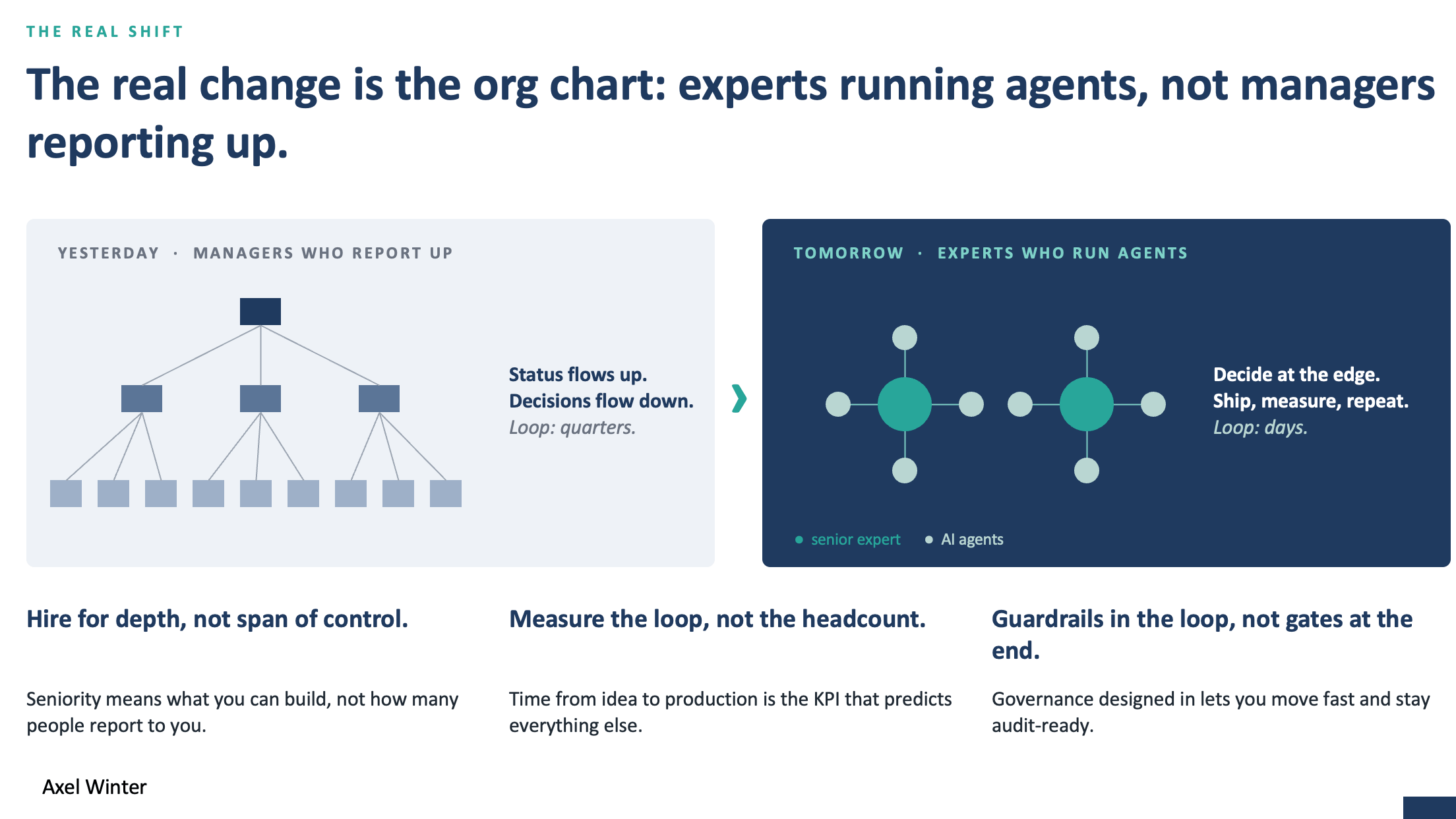
To achieve that — and with the advent of incrementally giving everyone in the organization AI to support them, tools to set up their own agents, etc. — the organization itself starts to change.
What we have noticed in the journey so far is that roles that mostly consolidate and report information have less to do — and less influence within the organization.
Executives and managers who have deep skills in their respective areas, however, become busier. They can do more themselves — why is that?
For me, I have different agents check my inbox, documents and instant messaging tools, and AI generates dashboards and focus areas and makes suggestions on what to follow up on. I create new agents with activities and feedback loops based on the insights provided — creating PowerPoints, new and more complex stories.
Meaning: with real expertise I have more leverage, because I can contribute more. Standard reporting can be outsourced to AI.
Teams across different functions will be more self-sufficient; knowledge workers and expertise support this way of working significantly.
Organizations are shifting from span of control and hierarchy to domain-based expert teams executing and working tightly together.
Startups driving transformation
Through the firm I am invested in, Pivot Digital, I have had the chance to engage multiple startups we are now teaming up with to drive the AI transformation agenda forward.

Legacy migration
Using AI agents to understand legacy platform code and data, such as on AS/400, mainframe or older Java applications. Together with professional experts, a model is prepared to translate these old, often functionally rich applications into new technology semi-automatically. This is a critical step of technology transformation that many large corporates still haven’t completed (the first transformation wave, 2005–2015): while their capabilities are limited, these platforms are typically very low in cost and yet require a high investment to replace — making it nearly impossible.
Where a global consultancy like Accenture, PwC or IBM might charge USD 40M, this startup would charge less than 2% of that number — and effectively enable insourcing and continuous development.
Next-generation consulting
IT systems gather a lot of data, and if all system data is combined smartly, the productivity ratio of an organization becomes transparent and actionable.
This startup essentially provides a tool companies can deploy that generates a report card on the firm’s productivity and recommendations on what to fix. These recommendations can also be automatically developed and given to staff. This is the scenario where AI agents from another firm run in your ecosystem to learn and recommend in iterations (loops), becoming better with each pass.
Simple yet powerful.
Two AI ecosystems in the enterprise
Broadly speaking, there are two types of AI ecosystem that co-exist and enrich each other in larger enterprises.

The end-user productivity layer
The reality is that most users will not be too in-depth or tech-focused; they just want to leverage a toolbox at their disposal to accelerate or adjust their existing work. This is the world of Microsoft Copilot and Fabric, Gemini for Google Workspace or, to name a neutral one, Glean.
Essentially, it gives end-users a chat with diverse features around image, video, document and other digital output. It mostly allows search and summary across all the standard software connected — MS Office, Google Workspace, SAP, Oracle, Salesforce, etc. These platforms are also starting to offer agents that can proactively execute work and workflows for users.
This is where change begins — and where cost grows. In my view it is a mandatory expense, whether bought or self-developed, like having e-mail. A lot of our current work circulates around these standard productivity tools, and connecting them to data warehouses/data lakes and key app ecosystems can support productivity.
The AI Center of Excellence
The other is the Center of Excellence approach: a small group of experts with a detailed understanding of the whole ecosystem — the business and the technology — who build what the toolbox can’t. This is also the team the AI Ambassadors bring their opportunities to. What this team needs to master:
- Business and context of the organization — how the business actually makes money, where the friction is, and what a good outcome looks like in each unit. Without this, every AI project stays a demo.
- Strategic goals of the organization — the handful of goals the AI agenda must move: revenue, productivity, time to value. This is what lets the team say no to use cases that don’t move them.
- Technical landscape and architecture — which systems hold which data, how they talk to each other, and where AI can plug in without a two-year integration program.
- Business and data model understanding — the entities behind the business (customer, tenant, product, transaction) and how they are represented in data. This is the context that makes a model useful to you and useless to a competitor.
- AI models (GPT, Claude, Gemini, Kimi, DeepSeek, etc.) — the foundation models themselves. The skill is knowing which model fits which task at what cost, and switching when a better one ships — not training your own.
- AI harness (LangGraph and others) — the runtime that runs the loop around the model: plan, call tools, read the results, remember, delegate, act. Orchestration lives here — and so do most of the guardrails that are still missing today.
- Inferencing — running models in production: latency, cost per call, token budgets, and the choice between API, cloud and on-premise serving. This is the new infrastructure line in the IT budget.
- RAG (retrieval-augmented generation) — giving the model your documents and data at the moment it answers, instead of retraining it. The practical way to ground answers in your own knowledge.
- Agentic — the design pattern where the model doesn’t just answer but works toward a goal: deciding, calling systems, checking results, iterating.
- AI agents — the concrete, deployed workers built on that pattern: an inbox agent, a campaign agent, a service agent — each with a defined scope, tools and owner.
- Guardrails — policy checks before an action lands, per-tool permissions, verification of what comes back, human sign-off points and a kill switch. Designed into the loop, not added as a review at the end.
- Skills and tools — the written procedures and the system connections (APIs, MCP) an agent is allowed to use. The reusable library that makes the second agent faster to build than the first.
- AI SDLC — the software delivery method for AI: evaluations alongside test cases, version control for prompts and skills, monitoring in production, and a release cycle measured in days.
The harness is where most of this comes together — and where the guardrails are still missing today:

What are your next steps?
First of all, understand your IT budget! Yes, this is where it all starts.
The largest annual IT budget I have had to manage was over USD 1.3BN, and the smallest a few million USD. The basic principle is the same.
Understand your financial freedom: how much of your budget you can shift from what is committed to what you can freely invest, in alignment with the overall goals.
This is the essence of IT transformation. All other steps flow from this.
Your IT budget will likely have items like:
- Project budget: $X M
- SaaS vendors 1–10
- Software vendors 1–10
- Data center
- End-user cost (Wi-Fi, laptops, printers, etc.), some as capex and some as opex
- Cloud infrastructure
- Cybersecurity
- Corporate shared services (HR, finance, compliance, etc.)
- Payroll
Most likely your budget is set up as ‘keep the lights on’ (staff, cloud, must-have vendors, etc.), and that might equal 50–80% of your total budget. If it’s more, you are in crisis; if it’s less, you are better than I give you credit for.

Overall, it might be an IT cost-to-sales ratio of 2% for retail, or — as a target — cost-to-revenue of <5% for banks (most banks sit at 8% or more today). The trend should be to decrease this further.
You have a strategic AI goal of:
- All staff get end-user AI and agentic tools
- Key applications are AI- and agent-based
- Build new, innovative products and services that drive revenue and productivity (cost reduction) at the same time. Even if the business is growing, your budget must not increase — it stays where it is or reduces itself.
What are the needs here?
- A 30% cost reduction to fund AI tools and expertise in the team?
- 5 new headcount
- Claude Code for all product, UX/UI and developer staff
Now, which SaaS vendors can you remove easily?
- Contact center
- Campaign management
- Credit risk
- Middleware / ESB
- Content management
- Point of sale
- Analytics / CDP / etc.
- General tooling like time reporting, HR portals, etc.
Mind you, these projects are just there to give you financial freedom and to build capabilities. You simply replace the features you have, because you know them and the users using them know them. Focus on what you know.
The team is 1 x business, 1 x product and 1 x tech lead, with access to procurement to make sure contract terminations are done in a timely manner — this is the Replacement Squad. Others are involved as needed.
You need product managers, business and tech expertise — precisely so that you do not need to outsource the thinking. That would further increase your cost. Focus on transforming your budget.
With that comes an agile ‘can do’ mindset driving change.
In parallel, kick-start:
- AI Ambassadors in every team
- AI training for everyone
- Ensure everyone has out-of-the-box AI tools well integrated (the ‘Copilots’ of the world) and potentially 2–3 others
The kick-start phase can be completed within one month.

Now comes the hard part: we still need an overall AI and innovation strategy.
- A strategy project team developing a holistic master plan, with the first 10 specific projects and 12 months of work planned out to build the foundations
- Sales and marketing functions
- Business roles
- Enablement functions, including IT, need to be transformed
- KPI: new revenue and productivity increases — from project one. ROI must be established.
Part of this is rolling out an innovation program driven by the AI Ambassadors, who should be the most AI-educated staff in each department — and this includes the IT and tech functions. Everyone can innovate.
Each innovation project has:
- Define an initiative: < 1 week
- Develop a tool, function or feature: < 1 week
- Test in production: < 1 month
- Fail, tune or go big, based on KPI tracking
The decision on what goes ahead sits with an AI working team (AI Ambassador, product owner and tech lead, plus one senior executive). Slides are optional. Must-have: 12 a year!
That is the mix of activity and approach you need.
I have models and a methodology to support this, in case you would like to know more.
You must be logged in to post a comment.