
From pilots to platforms: what the leaders actually built, what it earned them, and what every CEO should do next.
Executive summary
Luxury has a demand problem, and the leaders have concluded that AI is the answer — not as a marketing garnish, but as operating infrastructure. Bain and Altagamma put the active luxury client base at roughly 340 million in 2025, down from 400 million in 2022, with another 20 to 30 million clients expected to go. Meanwhile the top of the pyramid now carries roughly 46 to 47% of all personal luxury spending, up from 30% in 2019. In a market where growth comes from depth rather than breadth, the winning capability is knowing the individual client better than anyone else, and serving her flawlessly, everywhere.
That is exactly what the leaders are building. This study draws on eight operators — LVMH, Brunello Cucinelli, Kering, Zegna, Hugo Boss, Mytheresa, Ralph Lauren, and Korea’s retail giants — and arrives at one conclusion: the pilot era is over, the platform era has begun, and the window to choose your stack is 12 to 18 months. The five-point CEO agenda is at the end.
Why now: a shrinking market that rewards depth
First, the contraction. The personal luxury goods market sits at roughly €358 billion. The more revealing number is engagement: only 40 to 45% of the addressable customer base actually bought anything in 2025, down from around 60% in 2022, and new customer acquisition fell 5% year on year. Alongside that, 70% of consumers say they are dissatisfied with today’s in-store experience and 90% find brand experiences interchangeable. Luxury’s core promise — being known — is failing at precisely the moment the client base is shrinking.
Second, the concentration. With aspirational clients exiting, top clients now account for 46 to 47% of spending, against 30% in 2019. Every point of retention, frequency and basket size at the top of the pyramid is worth multiples of what it was five years ago. Worth noting: Bain also finds that big-spender growth has plateaued, and warns that price elevation alone has left even ultra-wealthy clients feeling short-changed. Concentration is an opportunity, not a strategy.
Third, the interface shift. Two weeks ago I flagged Adobe’s Q1 2026 finding that AI-referred traffic to US retail sites grew 393% year on year, converting 42% better than non-AI traffic — a complete inversion from March 2025, when the same traffic converted 38% worse. That number has since moved again: Adobe’s May 2026 data shows AI-referred traffic converting 54% better. Morgan Stanley projects agentic shoppers at $190 billion in its base case and up to $385 billion in its bull case by 2030, or 10 to 20% of US e-commerce. Discovery itself is being rebuilt around AI agents.
A contracting market, a concentrating client base, and a machine-mediated front door. That is the context in which the following moves should be read.
The evidence: four layers of one stack
The leaders are not doing the same thing — they are each rebuilding a different layer. Read together, they form a complete stack, and a map of where any operator’s gaps are.

Layer 1 — The storefront: Cucinelli and Ralph Lauren
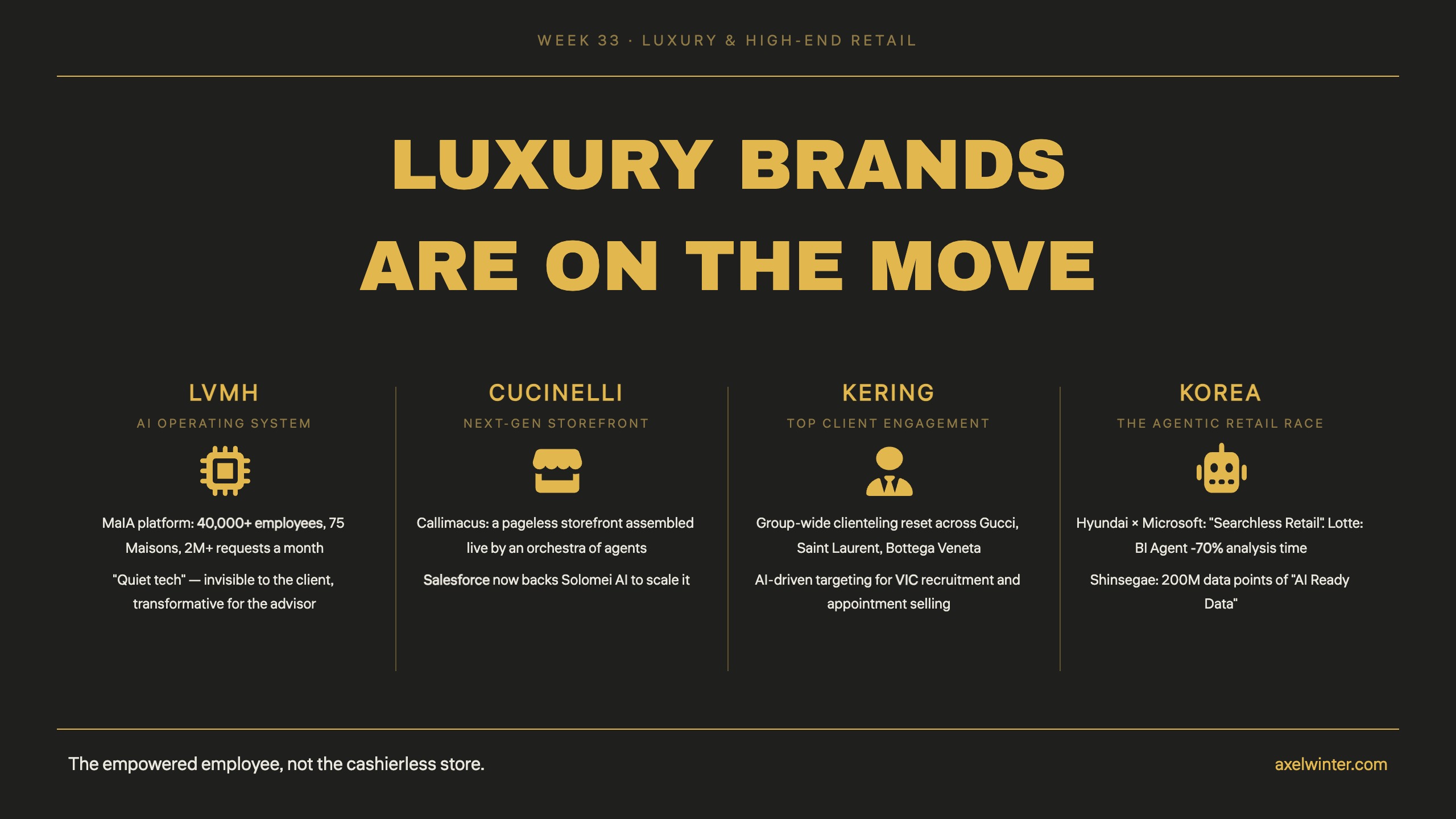
Brunello Cucinelli founded its own AI company, Solomei AI, in 2024 — mathematicians and engineers, plus philosophers and humanists, in a collaboration with Marc Benioff that began roughly three years ago. Its platform Callimacus powers a rebuilt e-commerce experience with no pages, no menus and no fixed paths: agents read each visitor’s intent and assemble the experience live, operating as a headless presentation layer over existing commerce systems. Since the January 2026 launch, visitor time has doubled, conversion is up, and more than 40 companies outside luxury have inquired. On 27 July 2026, Salesforce signed an investment agreement to scale Callimacus across Europe and North America, joining the Cucinelli family holding company as a shareholder.
Ralph Lauren took the conversational route: Ask Ralph, launched September 2025 with Microsoft Azure OpenAI, is a stylist in the app that returns shoppable, head-to-toe looks from live inventory. A month later the company expanded its Chief Digital Officer role to include AI strategy, giving AI a formal seat in the C-suite.
Layer 2 — The client relationship: Kering, Zegna, Mytheresa
This is where the revenue proof lives.
Kering created a group-wide Client division in March 2026, with a Chief Client Officer in seat on 4 May, rebuilding clienteling across Gucci, Saint Laurent and Bottega Veneta around VIC recruitment, appointment selling and lifetime value — with AI-driven client targeting as the mechanism. AI’s job here is not more messages, but better-timed human ones.
Zegna has the longest track record and the hardest numbers, and they are worth dating precisely because they have held up. As of its 2023 disclosures, the ZEGNA X clienteling system — built with Microsoft and Shin Software, with an AI configurator drawing on 49 billion outfit combinations — already accounted for more than 45% of revenue in directly operated boutiques, with clients served one-to-one through it spending 75% more than walk-ins. Investment behind it: more than €5 million a year. Read that again: nearly half of full-price retail revenue running through the clienteling channel, and that was three years ago.
Mytheresa proves the economics from the digital side: around 4% of its customers generate close to 40% of sales, per CEO Michael Kliger. That top-client program drove 13.4% net sales growth in the quarter to December 2024 while the broader market contracted.
Layer 3 — The internal operating system: LVMH and Hugo Boss
LVMH’s MaIA platform, built with Google Cloud on a data foundation started in 2021, serves 40,000+ employees across 75 Maisons and handles more than two million internal requests a month. One governed platform, many brand-specific agents: a retail agent at Celine answering complex questions from sales associates, a client outreach agent at Tiffany. The group’s framing — "quiet tech" — is the right ambition: invisible to the client, transformative for the advisor.
The number most CEOs skip is the human one. LVMH has trained some 1,500 data specialists over four years and put a further 15,000 employees through its Data and AI Academy. The platform is the visible artefact; the fluency is the actual investment.
Hugo Boss shows this layer is not only for conglomerates with LVMH’s balance sheet — and shows a route worth studying. Rather than build in-house, it formed a joint venture with the data and digital-commerce firm Metyis, which took the majority stake. The €15 million Metyis Campus in Gondomar, near Porto, houses the Hugo Boss Digital Campus, with 250 data and technology experts across Porto and headquarters in Metzingen, centralising analytics for e-commerce, merchandising and customer insight under the group’s "Claim 5" strategy. Hugo Boss plans to take full ownership of the campus in 2026. Buy the capability, operate it jointly, then own it: a materially faster path than recruiting 250 specialists from scratch, and the most transferable model in this study for any group that is not LVMH.
Layer 4 — The data and governance foundation: Korea
Seoul is building the layer underneath all of this, in public.
Hyundai had already shipped before it signed anything. HEYDI, launched in June 2025, was the Korean department store industry’s first AI shopping assistant: built on Azure OpenAI, it curates brands, restaurants, pop-ups and promotions inside the store in real time, assembled from what the customer says they want rather than from what they search for. It went to foreign visitors first, deliberately — tourists have the least access to in-store information. By the time Microsoft presented the results at its Seoul AI Tour in March 2026, monthly usage had grown roughly ninefold, from about 9,000 to 80,000, at a customer satisfaction score of 4.51. The domestic version layers on membership data, purchase history, preferred stores and visit times, and real-time location. Only then, on 4 August 2026, did Hyundai FutureNet — the group’s ICT affiliate — sign a strategic MOU with Microsoft Korea to scale it: an AI security and governance framework first, then AI-centric work environments, then retail-specialised agents built jointly by Hyundai FutureNet’s AI Lab and Microsoft’s AI teams, then commercialisation. Governance is pillar one, and it is being built after a live customer-facing service has already earned the right to scale. That order — prove it, then govern it, then industrialise it — is the part worth copying.
Lotte has gone at the operational layer: a generative BI Agent cutting analysis time by 70%, an AI Biz Center cutting tenant-onboarding review by 80%, and an AI operating system for offline stores with Naver.
Shinsegae did something no department store had done before. Working with Seoul National University’s Graduate School of Data Science under an MOU signed in January 2025, it processed roughly 200 million online and offline shopping records into what it calls "AI Ready Data" — structured so that a model can learn purchase history, visit patterns and brand affinity at the level of the individual rather than the customer segment. The resulting hyper-personalisation research was accepted at ICML in July 2026, the first time a Korean department store’s industry-academia work has landed at a premier machine learning conference. The AI Sales Agent built on it is slated for early 2027.
The moat is not the model. Everyone can rent the same models. Nobody can rent your data layer.
Five patterns behind the numbers
- Clienteling is a revenue line, not a service nicety. Zegna’s 45%-of-boutique-revenue and +75% client spend remain the most important figures in this study. Bain’s 46% top-client concentration tells you why.
- The interface is being rebuilt around intent. Cucinelli’s doubled dwell time and the Adobe conversion inversion point the same way: experiences assembled from intent beat catalogues navigated by effort.
- Ops agents pay back first. Lotte’s −70% and −80% came from internal and tenant-facing agents — unglamorous, fast, bankable. Customer-facing magic is funded by back-office math.
- Governance is the entry ticket, not the brake. Hyundai FutureNet’s security-framework-first sequencing and LVMH’s single governed platform are what allow agents to scale past the demo.
- The human is the product. Every winning play — advisor with perfect memory, stylist in the app, better-timed outreach — augments the person at the centre of the experience. The empowered employee, not the cashierless store.
The timeline: from philosophy to operating model

- 2021–25 — LVMH builds one unified data platform with Google Cloud
- 2021–23 — Zegna X moves from pilot to scale; reaches 45%+ of boutique revenue
- 2023 — Hugo Boss Digital Campus opens with Metyis in Gondomar, Portugal
- 2024 — Cucinelli founds Solomei AI
- Sep 2025 — Ralph Lauren launches Ask Ralph; AI elevated to the C-suite a month later
- Jan 2026 — BrunelloCucinelli.AI launches: the pageless storefront
- Mar 2026 — Kering creates its Client division; Chief Client Officer in seat 4 May
- Jul 2026 — Salesforce invests in Solomei AI / Callimacus; Shinsegae’s ICML acceptance
- Aug 2026 — Hyundai FutureNet × Microsoft Korea MOU, governance first
- Early 2027 — Shinsegae’s AI Sales Agent goes live
Outlook: the next 12 to 24 months
Pageless goes mainstream. Salesforce can route Callimacus into Commerce Cloud, whose 78 top North American online retailers accounted for more than $192.6 billion in 2025 web sales. If intent-assembled storefronts work beyond luxury, the search-and-category era ends on schedule.
Clienteling becomes a board metric. Expect VIC recruitment, clienteling-influenced revenue and appointment productivity to show up in results calls.
Agentic discovery becomes a P&L line. With AI-referred conversion now running above standard traffic and Morgan Stanley’s 10-to-20% share projection, "how do agents see our catalogue?" becomes a merchandising question, not an IT question.
Korea exports the blueprint. Governance-first, ops-agents-first is becoming the regional template, and Lotte’s offline-store AI operating system with Naver is built to travel.
The lock-in window closes. Stack decisions made in 2026–27 — model layer, governance layer, agent platform — will be very expensive to reverse by 2028.
The view from Bangkok
One structural difference matters for Southeast Asia. In Europe, the client relationship sits mostly with the brand, because the brand runs the boutique. Across much of this region, luxury is concentrated in a small number of mall operators and conglomerates — which means the richest behavioural data set, the one spanning brands, categories, dining, entertainment and payment, sits with the operator, not the individual Maison.
That is an advantage most groups here have not yet monetised, and Korea is the proof of what happens when someone does. Shinsegae’s 200 million records were only usable because someone did the unglamorous work of making them machine-readable first. Hyundai’s HEYDI is the same asset pointed at the floor: an assistant that curates brands, restaurants and pop-ups across an entire store, which is something only the operator of that store can build. The equivalent asset exists in Bangkok, Jakarta, Manila and Singapore. It is mostly sitting in silos.
The CEO agenda: five moves, in order
- Decide your stack deliberately. One governed platform, many brand agents — the LVMH pattern. The question is no longer whether to adopt agents, but which governance layer and which agent stack you standardise on before the ecosystem locks in around you.
- Fund the data layer before the agents. Shinsegae’s AI Ready Data and LVMH’s four-year platform build are the real story. Agents are the last mile, not the first.
- Make clienteling a revenue engine. Zegna and Mytheresa define the target state. Instrument it: clienteling-influenced revenue, top-client retention, advisor productivity.
- Start where the payback is fastest: ops and B2B agents. Lotte’s tenant onboarding is the low-risk muscle-builder before customer-facing deployment.
- Budget for fluency, not just licences. Forty thousand MaIA users did not happen by procurement; 1,500 trained specialists and 15,000 academy graduates did. Training and adoption are the platform’s real cost line — plan for it, and put AI in the C-suite as Ralph Lauren did, so it has an owner.
A pragmatic sequencing: months 0–3, data audit and governance framework; months 3–9, one ops-agent deployment plus a clienteling pilot with your strongest advisors; months 9–18, platform standardisation and agentic-commerce readiness — structured catalogue, protocol compliance — before the holiday season. And if you are not LVMH, look hard at the Hugo Boss route: a joint venture buys you three years.
Sources
Bain & Company and Altagamma, Luxury Goods Worldwide Market Study and "Finding a New Longevity for Luxury" (20 November 2025); Adobe Digital Insights, 2026 Q2 AI Traffic Report (16 April 2026) and May 2026 update; Morgan Stanley Research, agentic commerce outlook (December 2025); Google Cloud and WWD on LVMH and MaIA; Microsoft, Business of Fashion and FashionUnited on ZEGNA X (2023); WWD, The Interline and FashionNetwork on the Salesforce–Solomei AI agreement (27 July 2026); Hugo Boss Group and Metyis on the Digital Campus; WWD and Mytheresa investor releases on top-customer economics; Hyundai Department Store Group newsroom on the HEYDI launch (June 2025) and Microsoft Source Asia on the AI Tour Seoul results (26 March 2026); Seoul Economic Daily, Maeil Business and Technology Record on the Hyundai FutureNet–Microsoft Korea MOU (4 August 2026); Herald Business, etoday and Insight on Shinsegae’s AI Ready Data and ICML acceptance.
Disclaimer: the views and opinions expressed here are my own and do not represent the positions of my employers or any organisation I am affiliated with. Figures are drawn from published reporting and company disclosures as of 19 August 2026 and are sourced above. Nothing here is investment advice.
Axel Winter — building digital and AI business across Asia. A shorter version of this study runs in the AI Strategy Retail newsletter on LinkedIn.
One response to “Luxury Brands Are On The Move”
[…] asset that survives every model swap, every acquisition, every IPO. The same split runs through the four-layer luxury AI stack I mapped last week: the layer that compounds is the one the operator […]