
Last Friday, September 11th, 2026, I gave the keynote at the INSEAD alumni meetup in Bangkok and had the opportunity to share my thoughts on corporate, and indeed even startup, transformation. In short, I took a walk from Digital Transformation to the shift organizations are experiencing now with AI — but not only AI. There is also the new constant of global and national disruptive events every few weeks, generating immense pressure not only on individuals and governments, but also, and especially, on corporations of all sizes. That makes speed of change at the lowest possible cost the new currency.


Many people love to say, when talking about transformation, that the tech isn’t the issue — the mindset and the business change are. While the latter is true, in my view the ‘issue’ is end to end, and each part depends on the others.
Each organization needs to understand technology — meaning actually trying it out — and what its best application is for itself. Just reading reports and adopting best practices is not the same. The difficult part is to drive understanding across technology, digital products and services, and business change. And often the issue is not a lack of understanding; it is that change itself is the issue at the core.
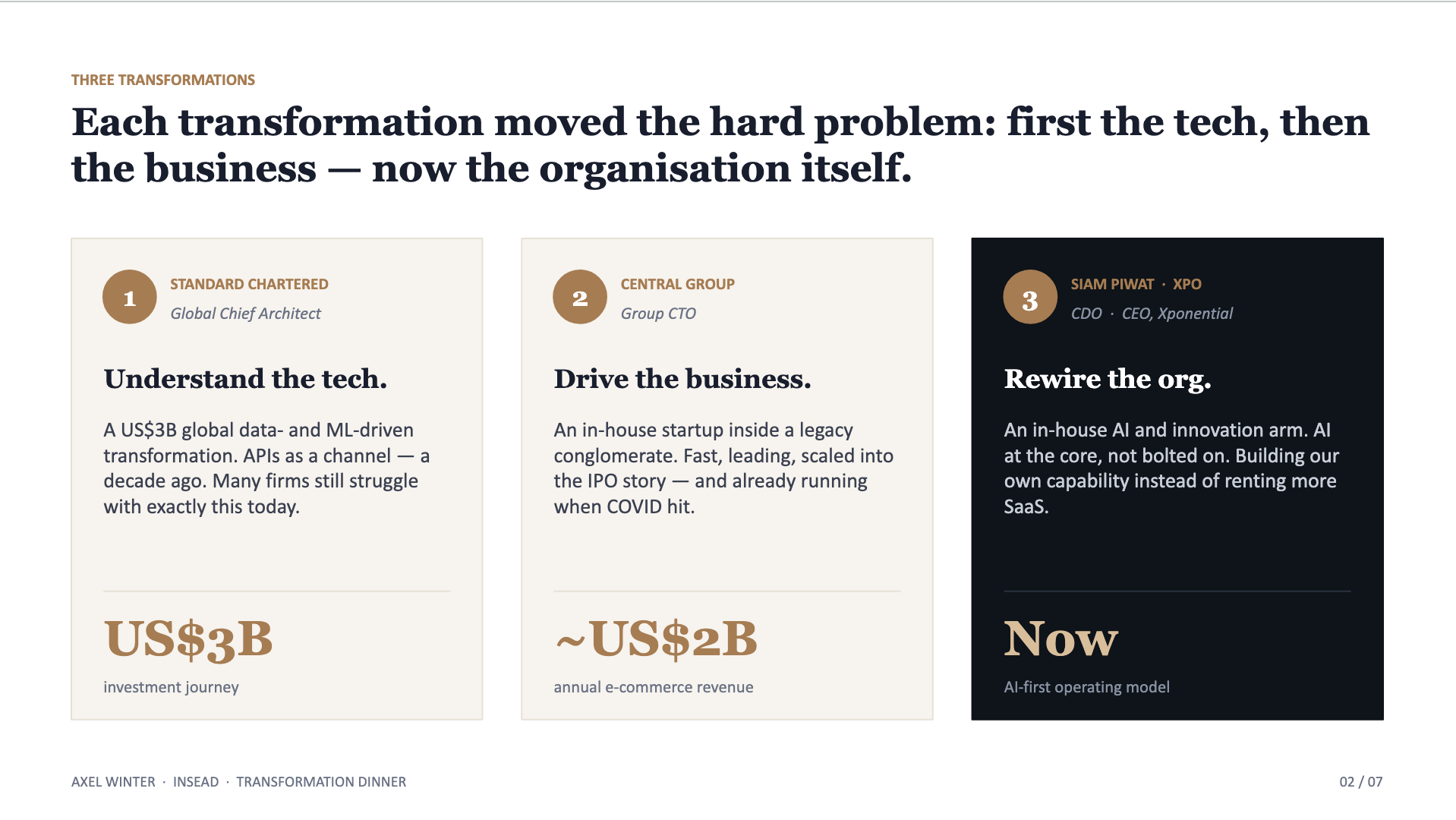
At Standard Chartered Bank, I was Global Chief Architect and Head of Technology Strategy across some 60 markets, managing over $1B in IT investment each year, with approximately $3B dedicated to transformation. SC is one of the 30 systemically relevant banks globally, focused mostly on Asia, the Middle East and Africa, with ‘on-ramps’ from Europe and North and South America, with approximately 16,000 IT staff at the time.
I started to renovate our own core banking system, paving the way to a modern, cloud-hosted, low-cost in-house option; transformed the API space, with core APIs abstracting (hiding) the legacy and developing API as a channel for the bank (embedded banking, Banking as a Service, etc.); and finally, with the release of the Hadoop open-source framework stack, built a global data lake for all business and enabling units. My team always learned and tested first, working with the delivery folks, and when ready we expanded and built scalable capabilities. That made its architecture and approach to data and machine learning one of the most advanced to date. We had people from other global banks trying to join my team because of its industry reputation. It was a good time. It is fun to work in a firm with lots of capabilities.
It also shows that learning, growing, strategizing, and changing the business can be done in a nucleus of a small yet highly capable team (roughly 3–4 people on each topic), yielding a better outcome than outsourcing it.
At Central, I refined the approach, and we built a startup within the group, reaching around 450 staff when I left and driving roughly 20% of the business through the new channels it generated. It became known as the ‘toughest and yet most fun’ job of a lifetime. My team members went on to become CTOs, CIOs, Product Leads, HR Heads and more across the top firms in Thailand, LINE and Bitkub included.
Retail is detail, and the challenge here was really to execute the maximum in a few months and transform a global business across Thailand, Vietnam, Italy and Germany in an ‘overnight’ rush.
The Group COO/President (aka my boss) and I developed the very first strategy and operating model, right down to the organizational footprint in the business units, all linking back to my core transformational engine.
We were lucky: when Covid hit and others scrambled to transform, we had to scale up, and we focused on expanding features for Covid times (e.g., click & collect in parking lots, live video sales, an internal C-COIN app with temperature-check management).
Then came Siam Piwat, and eventually the role of CEO of XPONENTIAL, the innovation and AI arm of the group. Here it is about driving a new AI operating model for a dynamic and highly customized business — using AI to build a smart, dynamic, expert-driven workforce.
Stop renting capability and build it in-house — to lower cost and yet drive rapid innovation, with AI-driven campaign management and gamification tooling, and many others. We are creating a new best practice that vendors and consultants haven’t yet thought about.
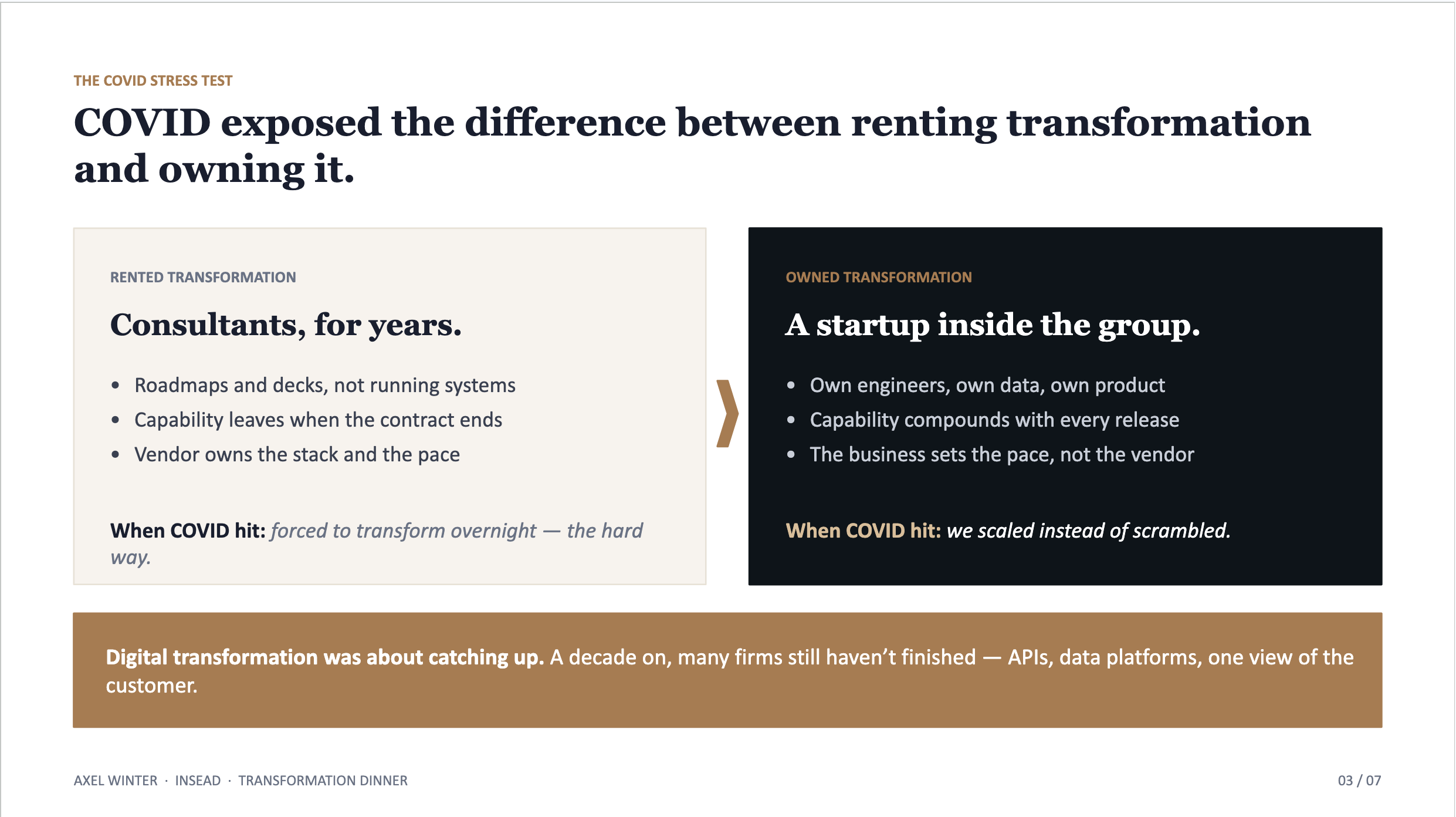
The top corporations and large startups hire most of the consultants and top vendors across the world. Just take a look at any reference slide: everyone lists pretty much every Fortune 500. These firms are big, multinational, and run many thousands of projects. So they hire everyone, somehow.
Typically, organizations react to new requirements and external forces driving new strategy — unlike our Central or Standard Chartered journeys — and over decades this has generated billions of dollars for the consulting industry. I was a consultant myself, with many very successful projects.
Yet when Covid hit, many organizations had to refocus on driving overnight transformations, rather than just scaling up, as in my Central story.
It strikes me: if I generated a scorecard over 10, 15 or 20 years of all the initiatives of the larger consulting firms, how would their combined power have impacted these organizations? I mean, if you had perfect advice, why would you need a digital transformation at all? Digital Transformation means: I need to catch up and digitize processes and business models. By that standard, it should not have been necessary.
That, exactly, is the difference between firms with high in-house capability, being continuously strategic, and firms that outsource thinking and doing to others.
A startup in the group is the sharp end: it mixes high-end capabilities with speed of change. That is the Olympic discipline and a must-have in today’s ecosystem.
It also drives the right culture for top talent to grow — and, yes, to enjoy.
Digital Transformation was about catching up: APIs, data, apps, etc. It is still not finished. We are at the start of AI transformations, and firms now again say that they need to get their data sorted first. That never came up with your consultants?
I put it clearly, to reiterate the point about responsibility: the executives are responsible.
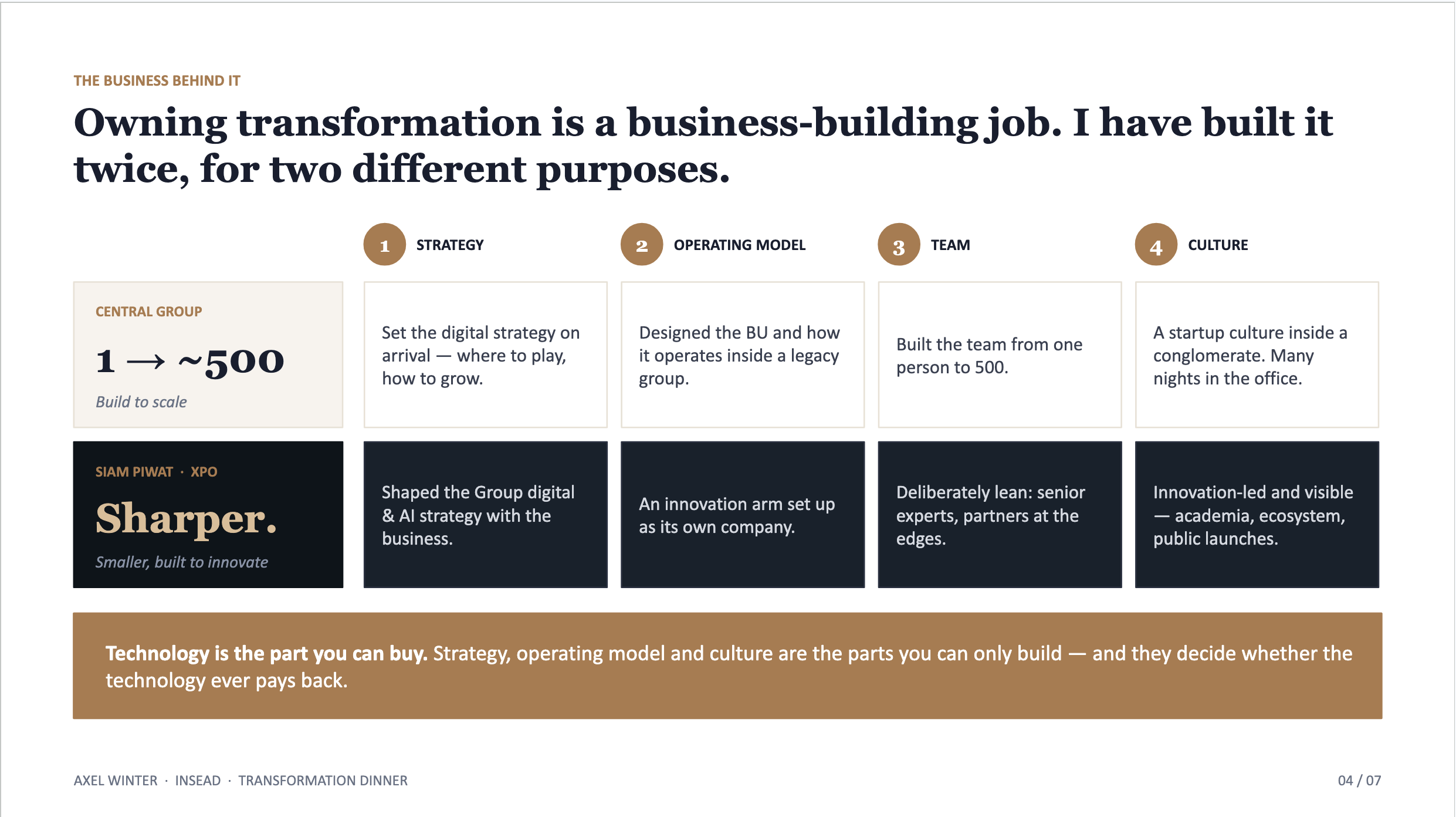
This standard journey has served me well in many organizations.
- Strategize and be clear. Our original strategy changed very little from the get-go to the day I left. We went much deeper and discovered new ideas in the depth, but the strategy and focus remained, and everyone was clear at all times. This includes technology strategy, architecture and approach (e.g., delivery model, timelines, etc.).
- Strategy alone doesn’t move a thing — it’s a PowerPoint, actually. The operating model has to call the shots and enable us to ‘play’ together. It is not the org chart that is critical here; it is how we work together, how we team, and how we execute. The fewest committees, and the most focus on rapid decision-making and clear ownership.
- Does IT get a budget or a P&L? The right answer is a P&L. Transformation is best measured in growth. A budget is spent to the penny, necessary or not; a P&L drives investment.
- IT should invest and ensure the best ROI. A data center? Cloud? Outsource or staff? At Central I even opened one of the first innovation centers of any corporate in Chiang Mai; many followed, and it was expanded when AWS joined — the first globally. It was, and still is, driving tremendous benefit for the group, in roughly 8-week innovation projects. The size of the investment or budget is by design, not by requirement. You can design it for almost anything — within a certain frame of reality.
- What skills do I need? What organization? What seniority? Take risk with people — allow them to grow, learn and contribute. In all my career, starting at Accenture, the first question for any new engagement was always: what is the best team I can assemble to get this job done? I have not failed a project I took over to this day — really true — and every single time it came down to a fantastic team backing me up (thank you all).
- The best teams need the best culture. No fear. Transparency. Empowerment. Openness to being different. Less org chart, more teaming and collaboration. Best idea wins.
That is the dynamic that drives top marks in execution.
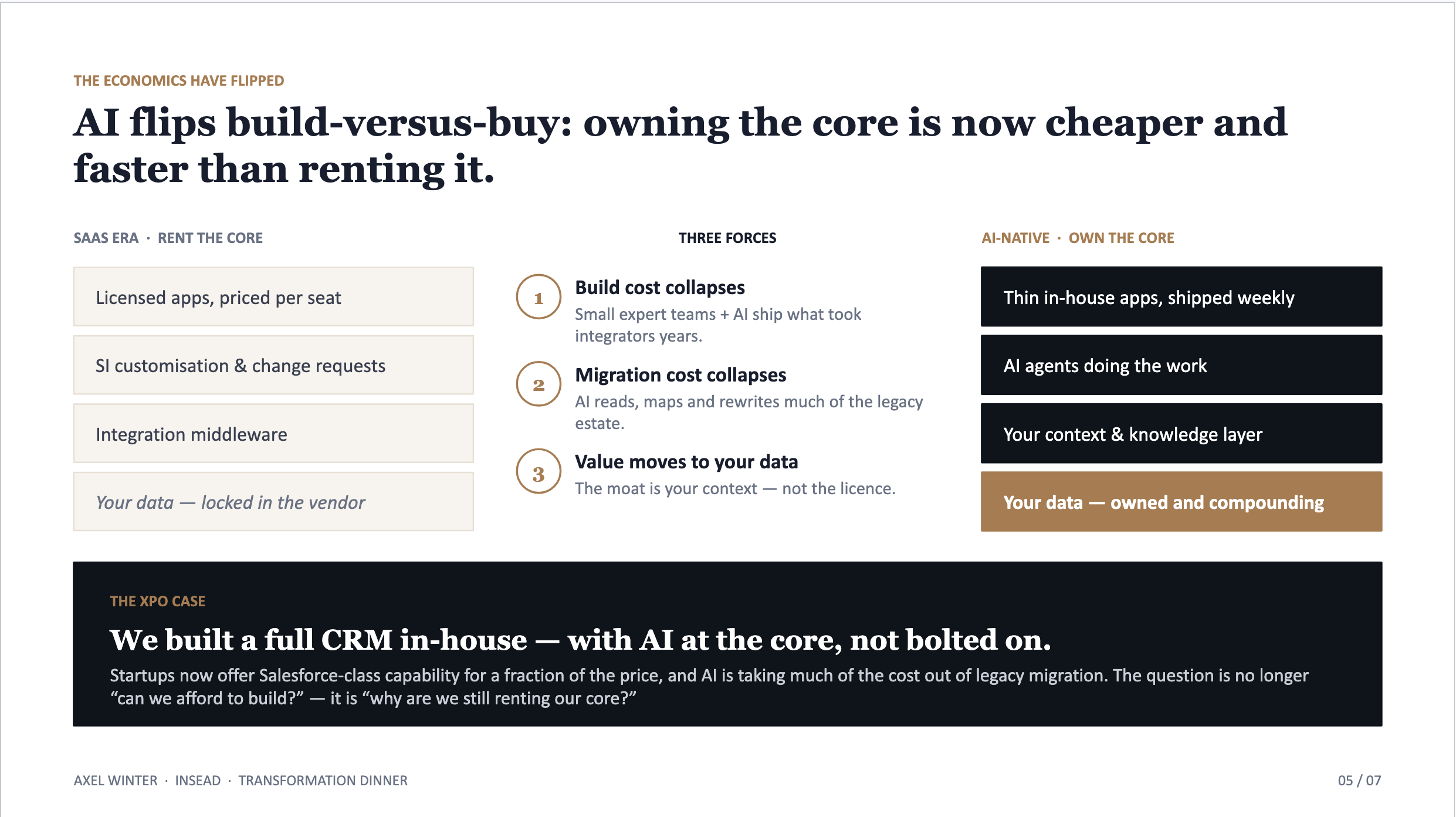
With absolute power comes absolute responsibility.
With AI, I have the power to create any feature and capability.
Two startups I came across recently:
- AI that analyzes legacy software on AS/400, mainframes or other legacy platforms and generates a new technology version — it has almost never lost an RFP head to head against the big consulting firms.
- AI that replaces SaaS (CRM, in this case) at roughly a third of the price, with all the features the customer needs — reducing pricing and improving innovation.
We, at XPONENTIAL, have done exactly that:
- Ecommerce
- Analytics
- Customer Data Platform
- Campaign Management
- Portal
- Personalization
- Gamification
- Industry Intelligence Platform
- and more
One of our interns just delivered, on Friday, with the coaching of my CTO, a new gamification platform: you select a game mechanic, upload media files (logos, etc.), set the rewards, and launch it in our OneSiam SuperApp. A project of roughly one month. Wow.
The new OneSiam SuperApp: we compressed our timeline by around 30%.
A CRM service module serving our contact centers: around two weeks.
Yes, you need experts to generate outcomes. We have them.
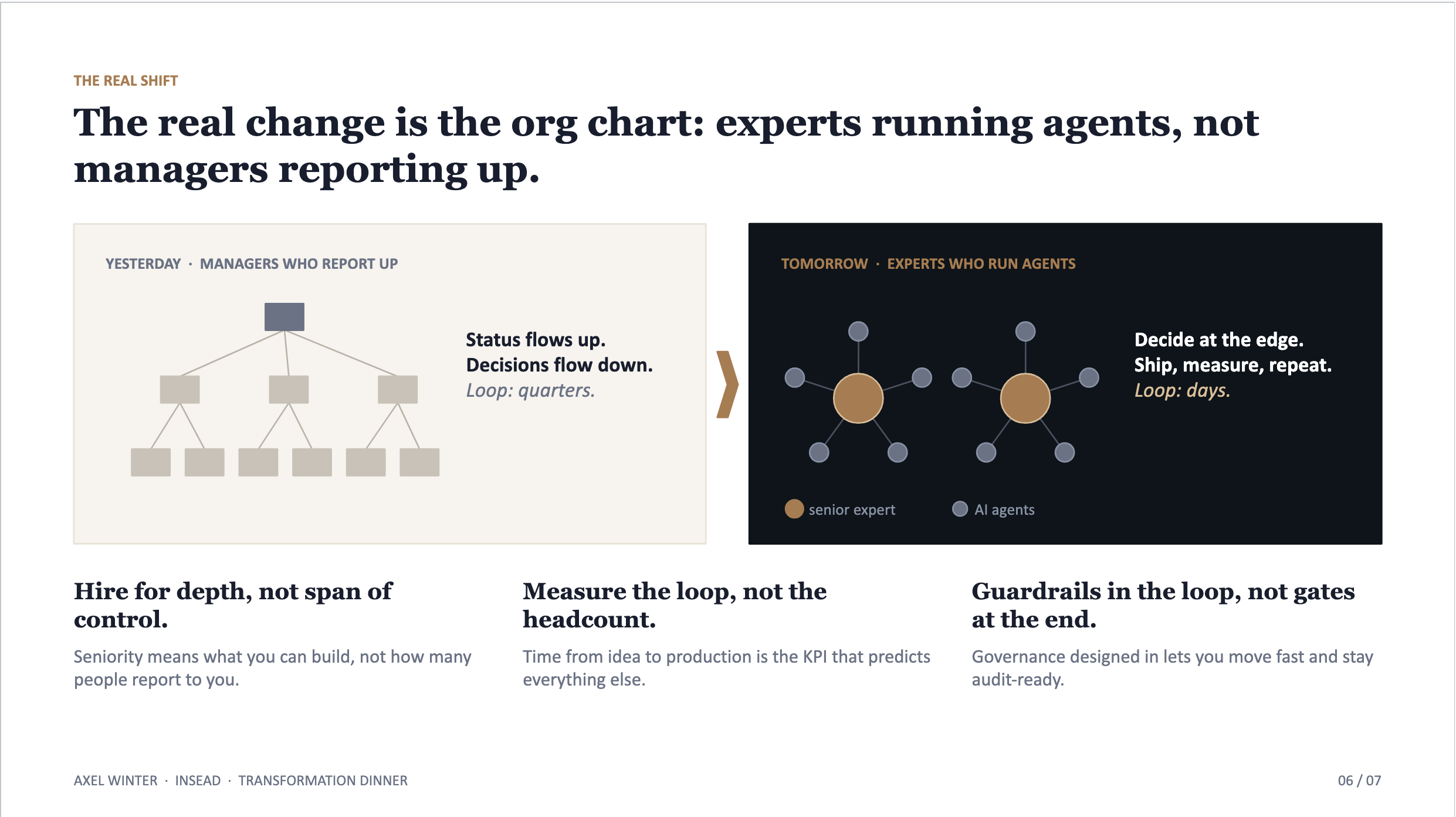
A manager or executive is defined by team size, not by skill or output. Managers of larger teams report up and go to committees to explain, and all of this takes a lot of time.
For an AI-agentic ecosystem, this is not necessary. We will need managers with expertise who contribute, orchestrate agents, coach team members, and link up with other experts — driven by knowledge graphs.
Siam Piwat is on that way. We are generating knowledge graphs, all staff receive AI training, and every department has AI Champions linking with my AI experts to consider improvements.
This will be the biggest shift in the history of work.
New models for new graduates will need to be found. Fast.
Loops drive improvements. AI and humans learn. Orchestrate.
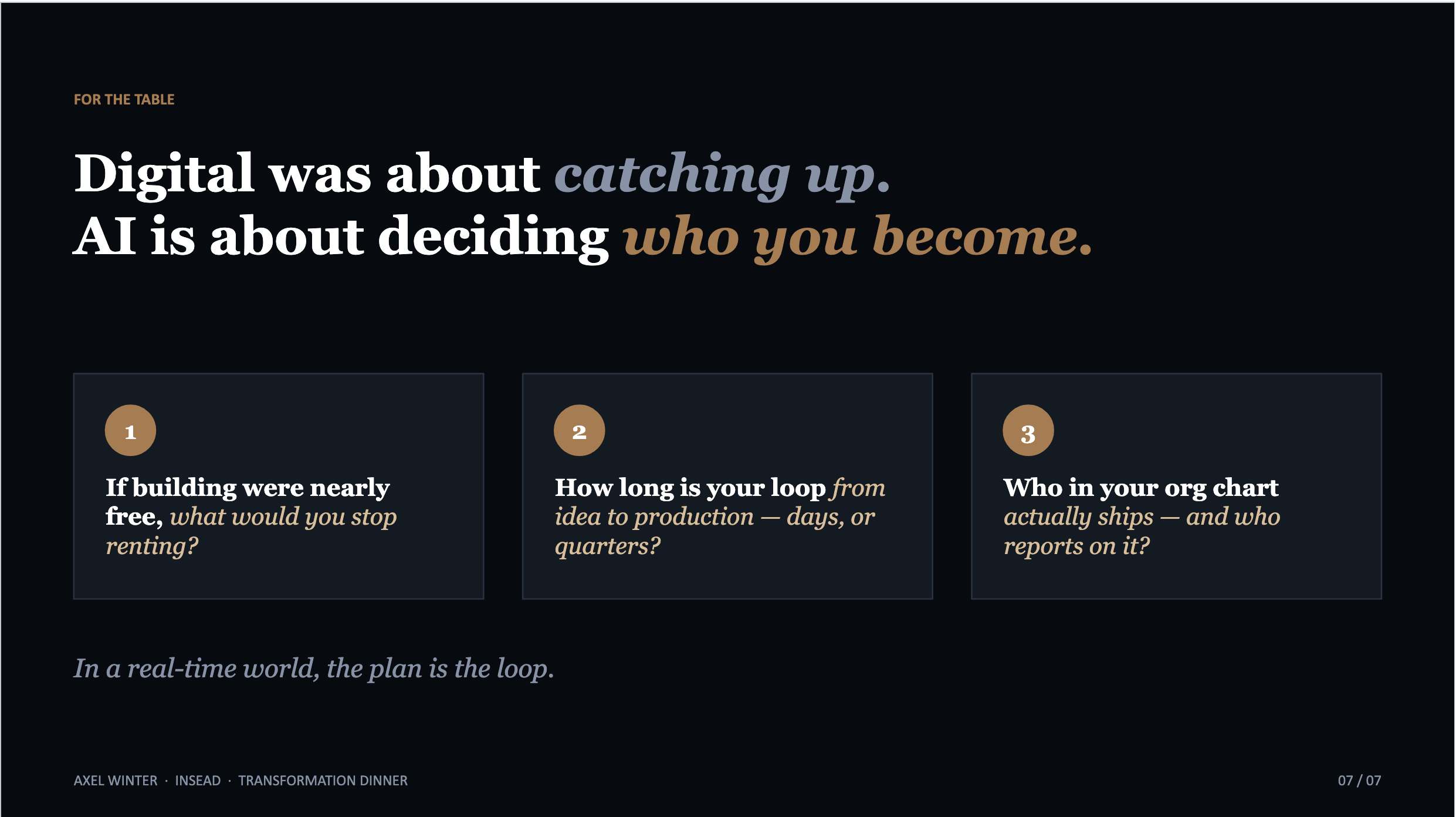
How do you use this power, if the only question is who you would like to be?
You can have any feature and any software, driving new products and services. What would that mean to you?
That is pure strategy. Every single day.
You must be logged in to post a comment.