
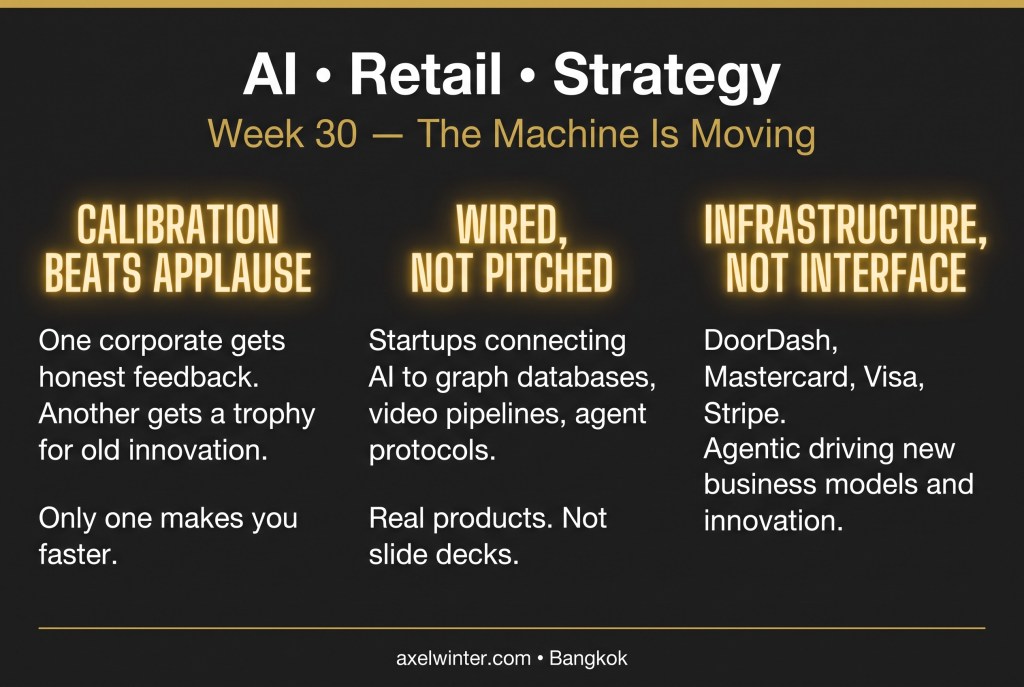

Three signals. Three layers. All moving at once. Curated from Bangkok.
🔹 Calibration Beats Applause
Last Saturday at the NIA ACC (ARI Corporate Coaching) Demo Day in Bangkok, a major Thai corporate pitched an invoice-scanning and automated bookkeeping solution. A retail executive on the judging panel asked the only question that mattered: why are you here? This can be built in a day.
That wasn’t cruelty — it was calibration. Put yourself in the room, take the hit, come back sharper. That is how corporate innovation actually improves.
The same week, CapitaLand Investment collected “Digital Transformation of the Year” at the Retail Asia Awards for receipt-free, payment-rail loyalty. A solid system — but Thai mall operators have been running payment-integrated loyalty for years. What wins awards in Singapore is the operational baseline in Bangkok.
Two corporates, both catching up. One received honest feedback. The other received applause for yesterday’s innovation. Only one of those makes you faster.
🔹 Wired, Not Pitched
Across two events in two cities, the same pattern kept surfacing: builders are shipping products, not slide decks.
At the NIA ACC Demo Day in Bangkok: Scene Flow turns ordinary camera footage into movement intelligence and operational analytics. Kler builds AI-powered smart glasses for elderly care, in partnership with Mahidol University and Siriraj Hospital. MastGuard AI monitors critical infrastructure, already piloting in Ayutthaya. Punya packages pharmacy advice into an AI kiosk.
Two weeks earlier in Saigon, Asian AI Builder Week — the largest AI hackathon in Asia, 2,500 developers building for a full week — produced the same signal: Warrant, guardrails for deploying commercial AI agents safely. We Maid AI, turning meeting transcripts into live corporate knowledge graphs. Robot Reincarnation, training robots from 30-second phone videos. And Alpha Tec, a Thai team that won the hospitality category with emotion-based kiosk recommendations.
The common thread is not the AI. It is what the AI is connected to — graph databases, video pipelines, agent protocols. These are products wired into operational systems. The builders have moved past “can AI do this?” to “how do we deploy it?”
🔹 Infrastructure, Not Interface
While corporates calibrate and startups build, the business model itself is shifting underneath both.
DoorDash quietly launched dd-cli — a command-line tool that lets AI agents place orders directly. No browser, no app, no human interface at all. Commerce built for machines. That is not a consumer feature; it is a new business model — infrastructure any agent can plug into.
Mastercard, Visa, and Stripe are laying the payment rails for the same shift: agent-to-agent transactions rather than human-to-merchant checkouts. These are not UI layers. They are protocol-level infrastructure — the kind others will build on.
Agentic commerce is not coming. It is already processing real money. The retail interface is dissolving into API calls between machines.
💡 The Pattern
Three layers, all moving at once. Corporates catching up — some honestly, some theatrically. Builders wiring AI into operational systems instead of pitch decks. And the business model evolving past the human interface entirely — infrastructure for agents, not storefronts for humans.
The machine doesn’t wait. The only question is which room you’re in.
AI · Retail · Strategy is published weekly by Axel Winter. Curated from Bangkok. No listicles, no hype cycles. axelwinter.com