

Three signals at the intersection of AI, retail, and business strategy in Asia. Curated from Bangkok.
📡 Starbucks Dumps IBM and Microsoft to Build Custom Operational AI
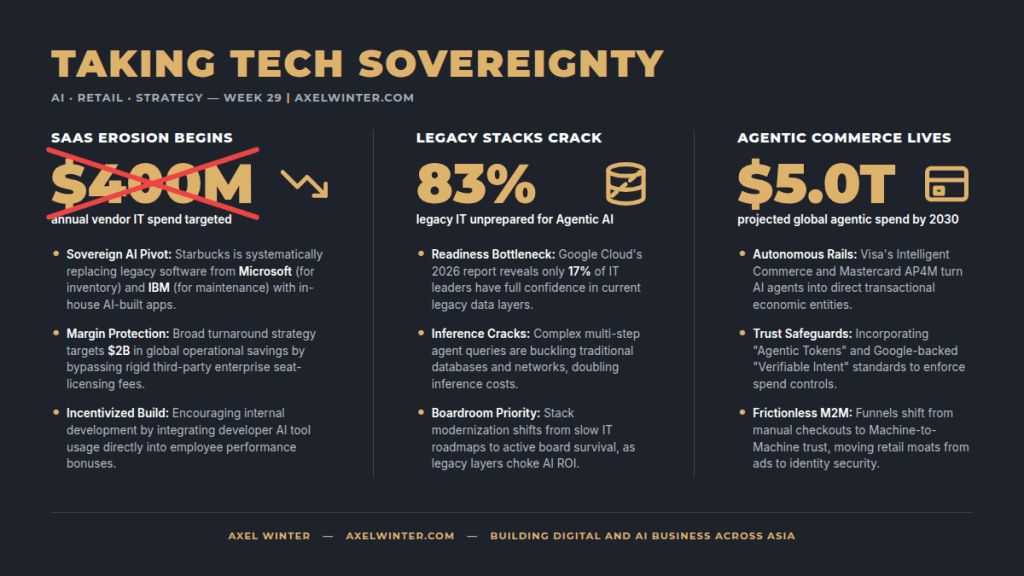
Starbucks is systematically replacing legacy software from Microsoft (for inventory tracking) and IBM (for store maintenance) with its own in-house, AI-built applications to target its $400 million annual software spend and shave off $2 billion in global operational costs. As generative AI and AI-assisted coding collapse development cycles, paying heavy per-seat SaaS taxes to legacy vendors makes no financial sense. If a physical retail giant managing 38,000+ stores can run its logistics on custom, AI-built code, mid-market enterprises have no excuse.
📡 The Legacy IT Stack Cracks Under Agentic AI Pressure
Google Cloud’s 2026 State of AI Infrastructure report reveals that 83% of senior IT leaders admit their current tech stacks and legacy architectures cannot support production-grade, autonomous AI agents, with only 17% expressing full confidence. As organizations transition from simple text chatbots to active agents, underlying databases and storage layers are buckling under high-frequency query pressure, driving soaring inference costs. Upgrading legacy tech stacks is no longer a slow-moving, back-office IT roadmap project—it is a boardroom priority and the single biggest bottleneck to capturing real AI returns.
📡 Visa and Mastercard Lay Down the Payment Rails for Autonomous Agents
Payments giants are racing to build the transaction infrastructure for autonomous AI: Visa is rolling out its “Intelligent Commerce Connect” (with OpenAI ChatGPT payment integrations), while Mastercard has launched “Agent Pay for Machines (AP4M)” featuring secure “Agentic Tokens” and “Verifiable Intent” trust standards. With McKinsey projecting that Agentic Commerce will drive $3 trillion to $5 trillion globally by 2030, these secure, tokenized financial rails are turning agents into active economic entities. This critical enablement layer shifts the competitive landscape from traditional ad-clicks to platform trust and Machine-to-Machine (M2M) transaction security.
💡 The Pattern
Friction is evaporating from both ends of the operational and transactional funnel. As enterprises bypass traditional SaaS seat-licensing to build custom AI-powered core applications, their backend IT stacks are cracking under the pressure of continuous, agentic query workloads. To survive and capture real ROI, boards must modernize their underlying data layers and integrate the newly emerging machine-to-machine payment rails from Visa and Mastercard—enabling these custom in-house systems to not just analyze, but securely act and transact in the physical world.
💡 Need Help with Your AI & IT Transformation?
Building custom operational tools, modernizing legacy databases, and integrating autonomous transactional rails is exactly what I do. At XPONENTIAL and through our transformation work at Siam Piwat, we have designed and built these sovereign AI systems from the ground up, proving that you can bypass expensive SaaS licensing while maintaining complete technological control.
If your board is struggling with soaring inference costs, legacy IT bottlenecks, or deciding between “build vs. buy” for AI, reach out. Let’s discuss how to modernize your stack for the agentic era.
Axel Winter is CEO at XPONENTIAL and PIVOT DIGITAL, building digital and AI businesses across Asia. Get in touch via axelwinter.com.