
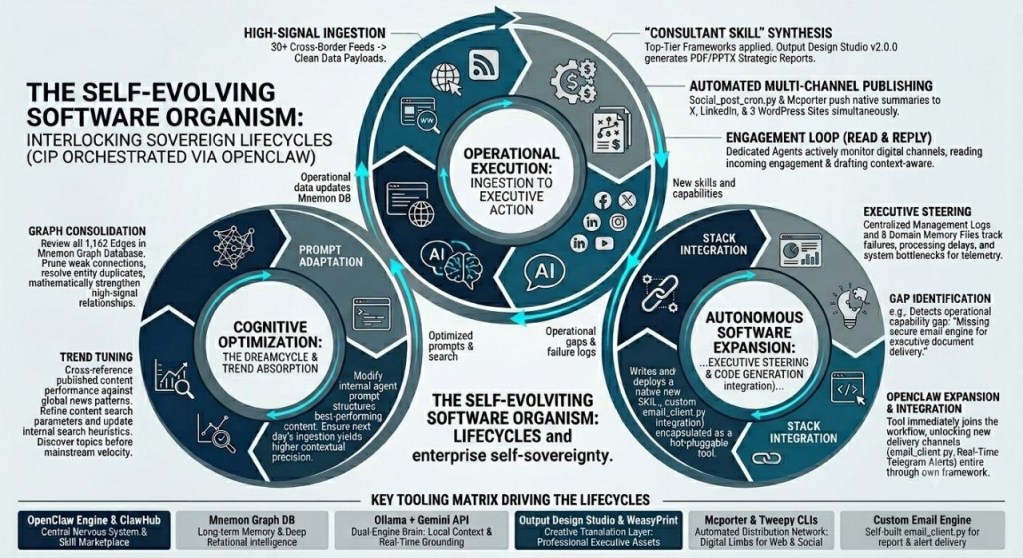
The Self-Evolving Software Organism — inside the sovereign lifecycles of a solo-built content & intelligence platform.
I built and run this on a single personal Linux machine — solo, no engineering team behind it, a side project carried alongside the day job. Three weeks from first commit to production. What started as a way to automate research and publishing has turned into something stranger and more useful: a content and intelligence platform that ingests, reasons, publishes, and now extends its own codebase while I sleep. What follows isn’t a vision deck. It’s a teardown of what the system does once you let it manage its own lifecycle.
Most automated systems are fragile pipelines—rigid tracks of code that break the moment a variable shifts or a new business requirement emerges.
The Content & Intelligence Platform (CIP), orchestrated via OpenClaw, breaks this paradigm entirely. It does not just run tasks; it manages its own lifecycle. It operates as a self-sustaining digital organism driven by three interlocking flywheels: Operational Execution, Cognitive Optimization (The Dreamcycle), and Autonomous Software Expansion.
By combining custom algorithmic capabilities like the Consultant SKILL with a self-documenting code evolution layer, this solo-engineered platform moves beyond simple automation into true enterprise self-sovereignty.
1. The Operational Flywheel: From Ingestion to Executive Action
The frontline of the platform is a continuous, high-velocity loop managed by autonomous agents executing synchronized actions. It bridges raw data collection with C-suite level output and active community engagement.

[Agent Inputs / Crons] --> [Consultant SKILL Synthesis] --> [Multi-Channel Distribution] --> [Feedback Loop: Read & Reply]Step A: High-Signal Ingestion
Autonomous cron agents (blogwatcher, web crawlers) relentlessly sweep the global web, filtering noise from 30+ cross-border feeds. They convert unstructured web traffic into clean data payloads.
Step B: The “Consultant SKILL” & Strategic Reporting
Raw data is useless to decision-makers. The platform passes these payloads into its proprietary, self-created Consultant SKILL. Acting as a virtual management consulting team, this skill applies elite frameworks (the kind top-tier management-consulting teams deploy) alongside premium public templates.
Through the Output Design Studio v2.0.0, it automatically generates professional, publication-ready executive briefings, market maps, and strategic reports in flawless PDF and PPTX formats.
Step C: Automated Multi-Channel Publishing
Once an executive report is compiled, the content factory immediately spins off native summaries. The distribution engines (social_post_cron.py and Mcporter) automatically publish targeted insights across X, LinkedIn, and three independent WordPress sites simultaneously.
Step D: The Engagement Loop (Read & Reply)
The lifecycle doesn’t end at publishing. Dedicated agents actively monitor these digital channels, reading incoming engagement and autonomously drafting context-aware replies. The system maintains its own audience loop, sustaining brand presence entirely on autopilot.
2. The Cognitive Flywheel: The Dreamcycle & Trend Absorption
While the operational layer executes daily tasks, the platform uses a deeper, asynchronous cognitive loop to ensure it gets smarter every day. This is driven by the Andy-Dream-Cycle.
Instead of letting its knowledge graph become cluttered with stale data or transient noise, the system triggers an analytical “sleep state” during low-traffic night windows:
- Graph Consolidation: The system reviews all 1,162 edges in the Mnemon Graph Database. It prunes weak connections, resolves entity duplicates, and mathematically strengthens high-signal relationships.
- Trend Tuning: By cross-referencing published content performance against incoming global news patterns, the Dreamcycle refines the system’s content search parameters. It updates its internal search heuristics, discovering what topics are gaining velocity before they hit mainstream feeds.
- Prompt Adaptation: The system modifies its own internal agent prompt structures based on what content resonated best, ensuring the next day’s ingestion yields higher contextual precision.
3. The Evolutionary Flywheel: Executive Steering & Software Expansion
The most radical attribute of this platform is its capability for Autonomous Software Expansion. Traditional software relies on a human developer to write integrations when a new requirement arises. This platform features an internal feedback loop that identifies its own operational gaps and expands its own codebase.
Executive Steering
Through its centralized management logs and 8 domain memory files, the platform tracks its own failures, processing delays, and system bottlenecks. This metadata provides an “executive steering” layer, giving the system clear telemetry on what it needs to optimize next.
Self-Directed Code Generation
When the platform detects an architectural limitation, it drafts the remedy. For example, when a gap was identified in secure executive document delivery, the system didn’t wait for manual plumbing — and it didn’t reach for a heavy third-party workspace wrapper either. It wrote its own lean delivery layer: a purpose-built email_client.py that is simpler, more reliable, and entirely under our control.
By writing and encapsulating its own new skills, the system expands its architectural footprint, unlocking new delivery channels — automated executive report distribution through that custom client, plus real-time Telegram alerts — entirely through its own framework.
4. How the Tooling Deeply Powers the Lifecycles
The platform’s underlying tooling matrix is not a fragmented collection of scripts—it is a tightly unified stack where every tool directly accelerates a specific phase of the sovereign lifecycle:
| Tooling Component | Role in the Ecosystem Lifecycle |
|---|---|
| OpenClaw Engine & ClawHub | The central nervous system. It manages the runtime environment, executes the 15 crons, and serves as the marketplace where new, self-generated skills are hot-plugged into the core architecture. |
| Mnemon Graph DB | The platform’s long-term memory. It allows the Consultant SKILL to query deep relational connections rather than flat keywords, turning raw news into structural intelligence. |
| Ollama + Gemini API | The dual-engine brain. Ollama runs local, deep-context processing for structural graph cleanup, while the Gemini API grounds search data in real-time, providing the linguistic accuracy needed to read and reply to user feedback. |
| Output Design Studio & WeasyPrint | The creative translation layer. This turns complex, abstract graph nodes into professional, visually stunning executive assets, executing the structural transition from raw data to premium consulting product. |
| Mcporter & Tweepy CLIs | The automated distribution network. They act as the physical limbs of the platform, giving the digital organism direct authoring and management permissions over corporate web and social assets. |
Custom email_client.py |
The autonomous execution arm for the software expansion cycle. A self-built, lean delivery layer — no third-party workspace dependency — that pushes executive reports and alerts straight into the pipeline. |
The Macro Verdict: This three-flywheel architecture represents a profound shift in software engineering. By handling its own operational output, analyzing its own data trends via the Dreamcycle, and dynamically expanding its own capabilities through OpenClaw skill generation, this Content & Intelligence Platform stands alone as a truly autonomous, self-evolving enterprise asset.
An Operator’s Note
Strip away the organism metaphor and the claim underneath is simple: a single person, with the right orchestration layer, can now operate a capability stack that until recently required a team. Ingestion analysts, a content desk, a junior consulting bench, a community manager, and the integration engineers who wire it all together — the CIP folds those roles into one runtime that I steer rather than staff.
That is the part worth sitting with for anyone running a technology organization. The question is no longer whether agents can do the task; they can. The question is what the smallest human core above a self-extending system looks like, and what that core does all day. Here, my work is steering and judgment — deciding which gaps are worth closing, reading the telemetry, and overruling the system when its confidence outruns its competence. The platform writes the skills; I decide which problems deserve one.
None of this is autonomous in the hands-off sense, and I’d be wary of anyone who sells it that way. It is deliberately architected, occasionally fragile, and wholly dependent on the quality of the steering layer. But it runs every day, and it was built by one person. That last fact is the point.
One response to “The Machine That Builds Itself”
[…] spent a Sunday morning building this. By Monday, it was running. Here’s the complete lifecycle — from morning news scan to […]