
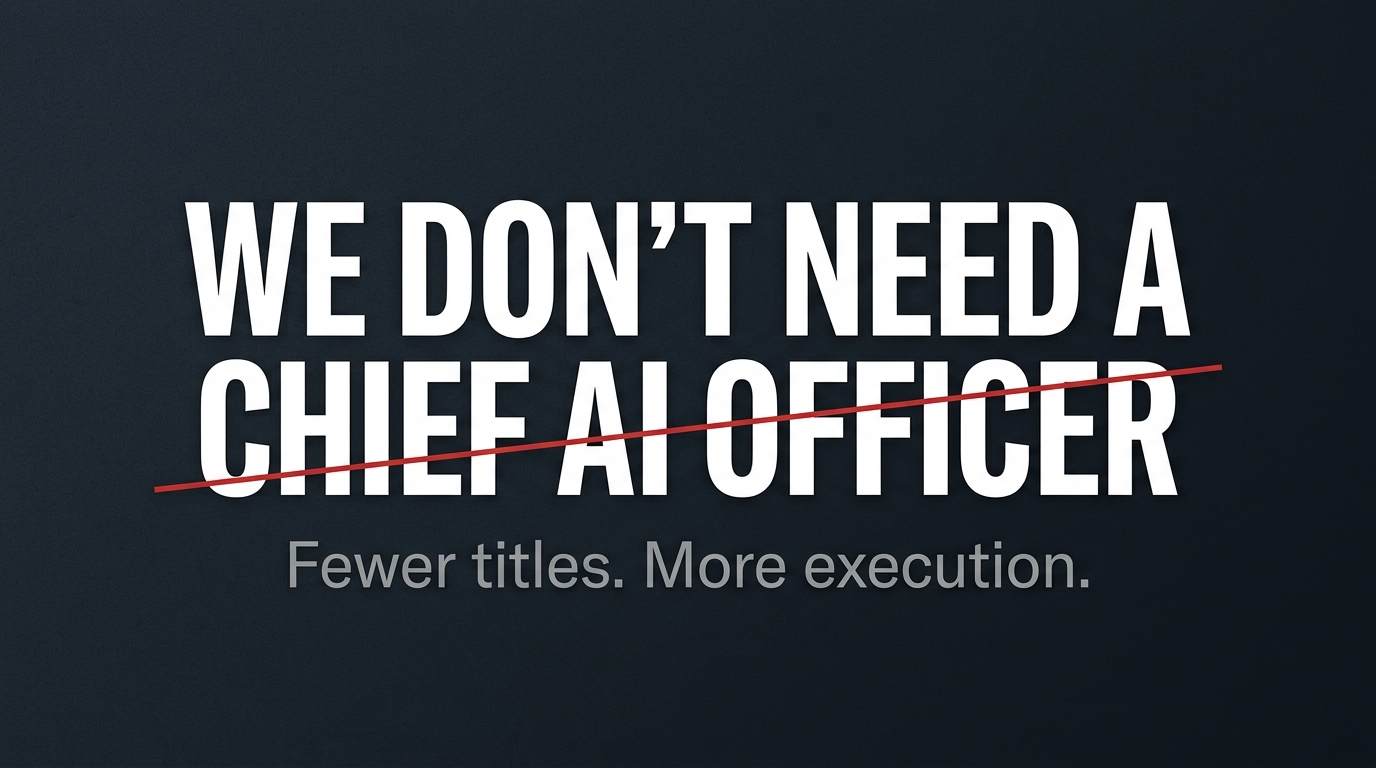
I’m tired of the alphabet. CAIO. CDO. CDAO. CPO. CTO. CIO. CTransO. And the one everyone’s fighting over right now: the Chief AI Officer — CAIO, depending on which consultant you paid.
Every one of these titles was minted faster than the authority that was supposed to come with it. A lot of chief AI officers today write strategy decks, review vendor demos, and get blamed for nothing when a model fails in production — because the CTO owns the outage and the CAIO never owned the budget. That isn’t leadership. That’s title inflation with a slide deck.
Here’s the thing most boardrooms are getting wrong, and it isn’t subtle.
The model is not the game.
You don’t build a foundation model. You rent one. OpenAI, Google, Anthropic, DeepSeek — pick one, and tomorrow you can switch to whichever gets cheaper or better. A corporation cannot win on “having AI” any more than it can win on “having electricity.” The model is a utility. That part of the debate is already over.
The framework is the game.
What you can build — and what almost nobody has built yet — is the layer that turns a rented model into something that actually does work. A real agentic framework: agents that reason across your systems, call your APIs, carry state through a ten-step workflow, escalate to a human when they’re out of their depth, and leave an audit trail afterward. That is where the differentiation lives. And that is where the industry is shockingly thin.
The surveys say it plainly. Roughly 70 to 90 percent of enterprises report piloting AI agents. Fewer than 20 percent have actually put agentic workflows into production. Fewer than 10 percent can point to a bottom-line impact. EY’s latest survey finds nearly half of executives admit their AI governance hasn’t kept pace with what they’ve already deployed.
Why? Because the framework is hard in ways a strategy deck can’t paper over.
First, reliability decays. A single AI step might be 95 percent accurate — fine. A ten-step agent is 0.95 to the tenth power: about 60 percent. A 40 percent failure rate is unusable in finance or operations, and if you bolt a human checkpoint onto every step, you’ve given back all the speed you gained. The industry hasn’t solved this; it’s mostly pretending it doesn’t exist.
Second, identity. Your security model assumes a human, or a service account with a fixed set of permissions. An agent acting on behalf of a dozen people across a dozen systems doesn’t fit that model. Give it broad keys and it’s a breach waiting to happen. Restrict it and it can’t do its job. This is an unsolved, unglamorous problem sitting dead center of the roadmap.
Third, churn. The agent frameworks everyone uses today — LangGraph, CrewAI, AutoGen, the rest — are young and moving fast. A library you build on this year may be deprecated next year. Enterprises are rightly scared to weld critical business logic to a framework that might not exist in eighteen months.
I say this as someone who had to build one, not just write about one. Xponential builds martech and insights services — and, amongst others, agentic systems for real enterprises. Every one of those three problems is real. I’ve paid to learn each of them, twice.
So what’s the answer? A Chief AI Officer?
No. That’s the trap.
The answer to “we have too many titles and not enough accountability” is not another title. It’s the opposite.
Fewer chiefs. More accountability. Strong expert teams. Execution.
One person who owns the outcome — the budget, the right to say no, and the blame when it breaks. Under them, a small team of people who have actually shipped an agent that touches real systems, not people who attended a summit. And a hard rule: nothing counts until it’s in production and tied to a number the CFO can see.
The companies that win the next five years won’t be the ones with the most complete C-suite org chart. They’ll be the ones that built the framework — the boring, unglamorous, half-broken layer where rented intelligence meets real work — while everyone else was still arguing about who gets the corner office.
We don’t need a Chief AI Officer. We need the agentic framework to actually exist, owned by someone with the authority to ship it and the accountability to answer for it.
Disclosure: I am CEO of Xponential and Pivot Digital — Xponential is martech and insights services, amongst others — and an independent director of GXBank. Views are my own.
Sources: EY AI governance survey (Sept 2026); enterprise agentic-AI adoption surveys (Dabase, Agentic AI Institute, 2026); MIT Sloan “agentic AI explained.” The 0.95¹⁰ ≈ 60% reliability math is a reasoning illustration, not a sourced statistic.